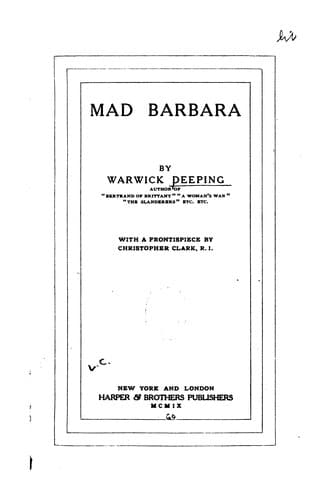
Great Britain -- History -- Charles II, 1660-1685 -- Fiction
It was all so simple, had he but known, as all great secrets seem when
they are once discovered. Your astrologist goes weaving grotesque
obscurities about man’s destiny and the stars, till one calm brain sets
the whole grand and reasonable scheme in order. Men wrote with
prodigious pomposity about a pump. “Nature abhors a vacuum,” quoth they.
And Nature, like a misunderstood woman, laughed in her sleeve, knowing
that the larger a wise man’s words are, the less he knows.
That Lionel Purcell’s death had left a great void in the girl’s life,
and that she still brooded over the violent mystery of it, of these
things John Gore felt assured. He could put no clear meaning to the mood
of yesterday, save that much grieving had left, as it were, an open
wound upon the brain, and that memory, touching it, would not suffer it
to heal. She had never given him one glimpse of the real purpose that
she cherished. Yet probably John Gore’s nag would have leaped forward
under a sudden slash of his rider’s spurs had the man been told what
Barbara had kept hidden from him in her bosom. As it was, her past life
appeared to him suffused with a wistful glow of infinite sadness,
infinite regret. Her face rose before him dim with a mist of autumn
melancholy. Her crown was a crown of scarlet berries woven and
interwoven amid the dark peril of her hair.
As for Barbara, she had fallen into a strange mood that day when John
Gore rode northward out of her life. She rose early, and walked alone in
the garden, showing an untroubled face to her mother when my lady
descended after taking breakfast in bed. Barbara, to appear occupied,
had a basket on her arm, and a pair of scissors with which she was
cutting off the dead flowers along the border.
Anne Purcell was a lady who had never bent her back over such a hobby.
“Such things were for maiden ladies with round shoulders and no bosoms.”
And the mother was a little inquisitive that morning, for John Gore’s
face had told her nothing the night before. Her wishes were all for an
understanding between the two, and she was not squeamish. The grip of a
man’s arm would hug the mopes out of the girl. Barbara needed hot blood
to teach her to live and to enjoy. My lady was wise in all these
matters.
“It is a new thing for you to touch the harpsichord, Barbe,” she said,
with that kindness that comes easily when people seemed inclined to
shape themselves to one’s wishes. “I will send Rogers to the City and
have a man out to tune the wires.”
Barbara reached for a dead flower, showing off her figure finely as she
leaned over the border—but there was no man there to see.
“You can have a singing-master again, if you wish for it, so that you
can sing to some one when he comes riding back from the North.”
She laughed and looked at her daughter with motherly archness. It was
good, at least, to see the girl busying herself even over such things as
dead flowers.
“My voice is not worth training.”
Public-domain text, read in full here on John Shaqi.
Reviews
Reviews
No reviews yet
Be the first to share your thoughts on this work.
Elsewhere in the archive
Join the Discussion
Join the discussion
Sign in to leave a comment or review.
Sign InorCreate an account