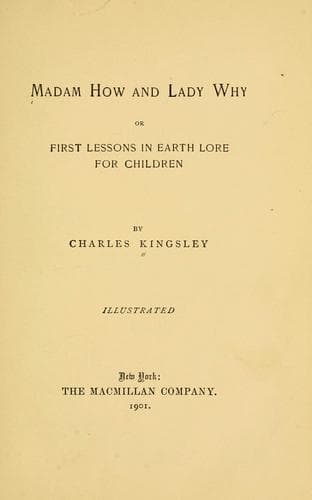
Madam How and Lady Why; Or, First Lessons in Earth Lore for ChildrenKingsley, Charles
History
Madam How and Lady Why; Or, First Lessons in Earth Lore for Children
Kingsley, Charles
Geology -- Juvenile literature; Natural history -- Juvenile literature
The man who saw it--a very good friend of mine, and a very good man of
science also--went last year to see an eruption on Vesuvius, not from the
main crater, but from a small one which had risen up suddenly on the
outside of it; and he gave me leave (when I told him that I was writing
for children) to tell them what he saw.
This new cone, he said, was about 200 feet high, and perhaps 80 or 100
feet across at the top. And as he stood below it (it was not safe to go
up it) smoke rolled up from its top, "rosy pink below," from the glare of
the caldron, and above "faint greenish or blueish silver of indescribable
beauty, from the light of the moon." But more--By good chance, the cone
began to send out, not smoke only, but brilliant burning stones. "Each
explosion," he says, "was like a vast girandole of rockets, with a noise
(such as rockets would make) like the waves on a beach, or the wind
blowing through shrouds. The mountain was trembling the whole time. So
it went on for two hours and more; sometimes eight or ten explosions in a
minute, and more than 1000 stones in each, some as large as two bricks
end to end. The largest ones mostly fell back into the crater; but the
smaller ones being thrown higher, and more acted on by the wind, fell in
immense numbers on the leeward slope of the cone" (of course, making it
bigger and bigger, as I have explained already to you), and of course, as
they were intensely hot and bright, making the cone look as if it too was
red-hot. But it was not so, he says, really. The colour of the stones
was rather "golden, and they spotted the black cone over with their
golden showers, the smaller ones stopping still, the bigger ones rolling
down, and jumping along just like hares." "A wonderful pedestal," he
says, "for the explosion which surmounted it." How high the stones flew
up he could not tell. "There was generally one which went much higher
than the rest, and pierced upwards towards the moon, who looked calmly
down, mocking such vain attempts to reach her." The large stones, of
course, did not rise so high; and some, he says, "only just appeared over
the rim of the cone, above which they came floating leisurely up, to show
their brilliant forms and intense white light for an instant, and then
subside again."
Try and picture that to yourselves, remembering that this was only a
little side eruption, of no more importance to the whole mountain than
the fall of a slate off the roof is of importance to the whole house. And
then think how mean and weak man's fireworks, and even man's heaviest
artillery, are compared with the terrible beauty and terrible strength of
Madam How's artillery underneath our feet.
Public-domain text, read in full here on John Shaqi.
Reviews
Reviews
No reviews yet
Be the first to share your thoughts on this work.
Elsewhere in the archive
Join the Discussion
Join the discussion
Sign in to leave a comment or review.
Sign InorCreate an account