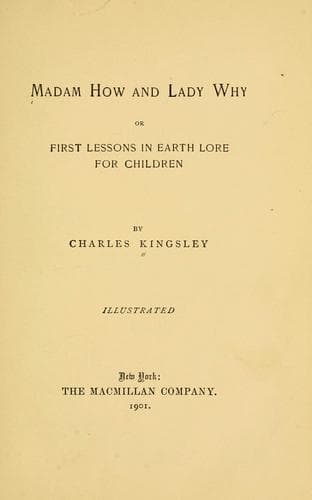
Madam How and Lady Why; Or, First Lessons in Earth Lore for ChildrenKingsley, Charles
History
Madam How and Lady Why; Or, First Lessons in Earth Lore for Children
Kingsley, Charles
Geology -- Juvenile literature; Natural history -- Juvenile literature
For see--down below, under the roots of the mountains, Madam How works
continually like a chemist in his laboratory, melting together all the
rocks, which are the bones and leavings of the old worlds. If they
stayed down below there, they would be of no use; while they will be of
use up here in the open air. For, year by year--by the washing of rain
and rivers, and also, I am sorry to say, by the ignorant and foolish
waste of mankind--thousands and millions of tons of good stuff are
running into the sea every year, which would, if it could be kept on
land, make food for men and animals, plants and trees. So, in order to
supply the continual waste of this upper world, Madam How is continually
melting up the under world, and pouring it out of the volcanos like
manure, to renew the face of the earth. In these lava rocks and ashes
which she sends up there are certain substances, without which men cannot
live--without which a stalk of corn or grass cannot grow. Without
potash, without magnesia, both of which are in your veins and
mine--without silicates (as they are called), which give flint to the
stems of corn and of grass, and so make them stiff and hard, and able to
stand upright--and very probably without the carbonic acid gas, which
comes out of the volcanos, and is taken up by the leaves of plants, and
turned by Madam How's cookery into solid wood--without all these things,
and I suspect without a great many more things which come out of
volcanos--I do not see how this beautiful green world could get on at
all.
Of course, when the lava first cools on the surface of the ground it is
hard enough, and therefore barren enough. But Madam How sets to work
upon it at once, with that delicate little water-spade of hers, which we
call rain, and with that alone, century after century, and age after age,
she digs the lava stream down, atom by atom, and silts it over the
country round in rich manure. So that if Madam How has been a rough and
hasty workwoman in pumping her treasures up out of her mine with her
great steam-pumps, she shows herself delicate and tender and kindly
enough in giving them away afterwards.
Nay, even the fine dust which is sometimes blown out of volcanos is
useful to countries far away. So light it is, that it rises into the sky
and is wafted by the wind across the seas. So, in the year 1783, ashes
from the Skaptar Jokull, in Iceland, were carried over the north of
Scotland, and even into Holland, hundreds of miles to the south.
Public-domain text, read in full here on John Shaqi.
Reviews
Reviews
No reviews yet
Be the first to share your thoughts on this work.
Elsewhere in the archive
Join the Discussion
Join the discussion
Sign in to leave a comment or review.
Sign InorCreate an account