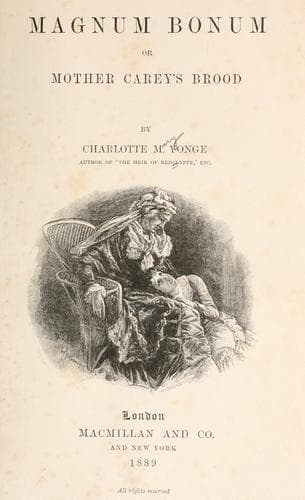
Magnum Bonum; Or, Mother Carey's BroodYonge, Charlotte M. (Charlotte Mary)
General
Magnum Bonum; Or, Mother Carey's Brood
Yonge, Charlotte M. (Charlotte Mary)
Domestic fiction; England -- Social life and customs -- 19th century -- Fiction; Religious fiction
“It may be only affectation,” said his lady, in a consolatory tone. “I
am afraid poor Joe did live with a very odd set of people--artists, and
all that kind of thing. I am sure I don’t blame her, poor thing! But she
is worse to manage than any child, because you can’t bid her mind what
she is about, and not talk nonsense. When she leaves her house in such a
state, and no one but that poor girl to see to anything, and comes home
all over mud, raving about fairyland, and gold trees and blue ground;
when she has just got into a bog in Belforest coppice--littering the
whole place, too, with common wild flowers. If it had been Essie and
Ellie, I should just have put them in the corner for making such a
mess!”
The Colonel laughed a little to himself, and said, consolingly, “Well,
well, you know all these country things are new to her. You must be
patient with her.”
Patient! That had to be the burthen of the song on both sides. Carey was
pushing back her hair with a fierce, wild sense of impatience with that
calm assumption that fretted her beyond all bearing, and made her feel
desolate beyond all else. She would have, she thought, done well enough
alone with her children, and scrambled into her new home; but the
directions, however needful, seemed to be continually insulting her
understanding. When she was advised as to the best butcher and baker,
there was a ring in her ears as if Ellen meant that these were safe men
for a senseless creature like her, and she could not encounter them with
her orders without wondering whether they had been told to treat her
well.
Indeed, one of the chief drawbacks to Carey’s comfort was her difficulty
in attending to what her brother and sister-in-law said to her.
Something in the measured tones of the Colonel always made her thoughts
wander as from a dull sermon; and this was more unlucky in his case than
in his wife’s--for Ellen used such reiterations that there was a fair
chance of catching her drift the second or third time, if not the first,
whereas all he said was well weighed and arranged, and was only too
heavy and sententious.
Public-domain text, read in full here on John Shaqi.
Reviews
Reviews
No reviews yet
Be the first to share your thoughts on this work.
Join the Discussion
Join the discussion
Sign in to leave a comment or review.
Sign InorCreate an account