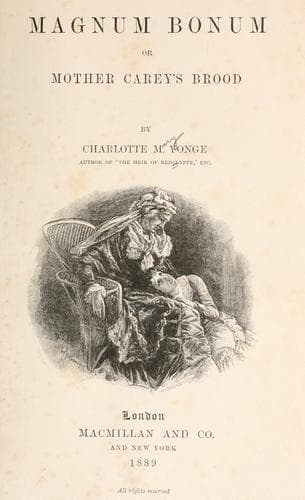
Magnum Bonum; Or, Mother Carey's BroodYonge, Charlotte M. (Charlotte Mary)
General
Magnum Bonum; Or, Mother Carey's Brood
Yonge, Charlotte M. (Charlotte Mary)
Domestic fiction; England -- Social life and customs -- 19th century -- Fiction; Religious fiction
“Why?” interposed Allen, “because we are raw cockneys, who go into
raptures over primroses and wild hyacinths, eh, Jessie?”
“Well, you have set them up very nicely,” said Jessie; “but fancy taking
so much trouble about common flowers.”
“What would you think worth setting up?” asked Janet. “A big dahlia, I
suppose, or a great red cactus?”
“We have a beautiful garden,” said Jessie: “papa is very particular
about it, and we always get the prize for our flowers. We had the first
prizes for hyacinths and forced roses last week, and we should have had
the first for forced cucumbers if the gardener at Belforest had not
had a spite against Spencer, because he left him for us. Everybody said
there was no comparison between the cucumbers, and Mr. Ellis said--”
Janet had found the day before how Jessie could prattle on in an endless
quiet stream without heeding whether any one entered into it or replied
to it; but she was surprised at Allen’s toleration of it, though he
changed the current by saying, “Belforest seems a jolly, place.”
“But you’ve only seen the wood, not the gardens,” said Jessie.
“I went down to the lake with Mr. Ogilvie,” said Allen, “and saw
something splendiferous looking on the other side.”
“Oh! they are beautiful!” cried Janet, “all laid out in ribbon gardens
and with the most beautiful terrace, and a fountain--only that doesn’t
play except when you give the gardener half-a-crown, and mamma says,
that is exorbitant--and statues standing all round--real marble
statues.”
“Like the groves of Blarney,” muttered Janet:
“Heathen goddesses most rare,
Homer, Venus, and Nebuchadnezzar,
All standing naked in the open air.”
Allen, seeing Jessie scandalised, diverted her attention by asking,
“Whom does it belong to?”
“Mr. Barnes,” said Jessie; “but he is hardly ever there. He is an old
miser, you know--what they call a millionaire, or mill-owner; which is
it?”
“One is generally the French for the other,” put in Janet.
“Never mind her, Jessie,” said Allen, with a look of infinite
displeasure at his sister. “What does he do which keeps him away?”
“I believe he is a great merchant, and is always in Liverpool,” said
Jessie. “Any way, he is a very cross old man, and won’t let anybody go
into his park and gardens when he comes down here; and he is very cruel
too, for he disinherited his own nephew and niece for marrying. Only
think Mrs. Watson at the grocer’s told our Susan that there’s a little
girl, who is his own great-niece, living down at River Hollow Farm with
Mr. and Mrs. Gould, just brought up by common farmers, you know, and he
won’t take any notice of her, nor give one farthing for bringing her up.
Isn’t it shocking? And even when he is at home, he only has two chops
or two steaks, or just a bit of kidney, and that when he is literally
rolling in gold.”
Public-domain text, read in full here on John Shaqi.
Reviews
Reviews
No reviews yet
Be the first to share your thoughts on this work.
Join the Discussion
Join the discussion
Sign in to leave a comment or review.
Sign InorCreate an account