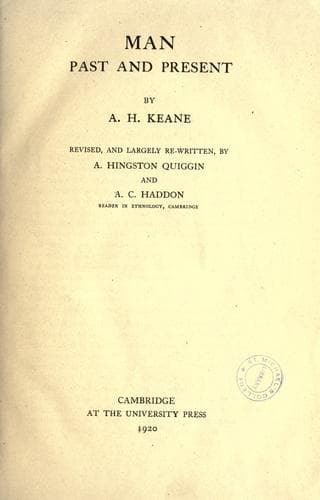
Man, Past and PresentKeane, A. H. (Augustus Henry)
History
Man, Past and Present
Keane, A. H. (Augustus Henry)
Anthropology; Ethnology
[190] The Buduma, who derive their legendary origin from the Fulahs whom
they resemble in physique, worship the _Karraka_ tree (a kind of
acacia). P. A. Talbot, "The Buduma of Lake Chad," _Journ. Roy. Anthr.
Inst._ XLI. 1911. The anthropology of the region has lately been dealt
with in _Documents Scientifiques de la Mission Tilho_ (1906-9),
_Republique Francaise, Ministere des Colonies_, Vol. III. 1914; R.
Gaillard and L. Poutrin, _Etude anthropologique des Populations des
Regions du Tchad et du Kanem_, 1914.
[191] III. p. 194.
[192] _Sahara and Sudan_, II. p. 628.
[193] II. pp. 382-3.
[194] That is "Kanem-men," the postfix _bu_, _be_, as in _Ti-bu_,
_Ful-be_, answering to the Bantu prefix _ba_, _wa_, as in _Ba-Suto_,
_Wa-Swahili_, etc. Here may possibly be discovered a link between the
Sudanese, Teda-Daza, and Bantu linguistic groups. The transposition of
the agglutinated particles would present no difficulty; cf. Umbrian and
Latin (_Eth._ p. 214). The Kanembu are described by Tilho, who explored
the Chad basin, 1906-9. His reports were published in 1914. _Republique
Francaise Ministere des Colonies, Documents Scientifiques de la Mission
Tilho_ (1906-9), Vol. III. 1914.
[195] Barth draws a vivid picture of the contrasts, physical and mental,
between the Kanuri and the Hausa peoples; "Here we took leave of Hausa
with its fine and beautiful country, and its cheerful and industrious
population. It is remarkable what a difference there is between the
character of the ba-Haushe and the Kanuri--the former lively, spirited,
and cheerful, the latter melancholic, dejected, and brutal; and the same
difference is visible in their physiognomies--the former having in
general very pleasant and regular features, and more graceful forms,
while the Kanuri, with his broad face, his wide nostrils and his large
bones, makes a far less agreeable impression, especially the women, who
are very plain and certainly among the ugliest in all Negroland" (II.
pp. 163-4).
[196] See Nachtigal, II. p. 690.
[197] For recent literature see Lady Lugard's _A Tropical Dependency_,
1905, and the references, note 3, p. 58.
[198] These are the same people as the _Tunjurs_ (_Tunzers_) of Darfur,
regarding whose ethnical position so much doubt still prevails. Strange
to say, they themselves claim to be Arabs, and the claim is allowed by
their neighbours, although they are not Muhammadans. Lejean thinks they
are Tibus from the north-west, while Nachtigal, who met some as far west
as Kanem, concluded from their appearance and speech that they were
really Arabs settled for hundreds of years in the country (_op. cit._
II. p. 256).
[199] A. H. Keane, "Wadai," _Travel and Exploration_, July, 1910; and H.
H. Johnston, on Lieut. Boyd Alexander, _Geog. Journ._ same date.
Public-domain text, read in full here on John Shaqi.
Reviews
Reviews
No reviews yet
Be the first to share your thoughts on this work.
Join the Discussion
Join the discussion
Sign in to leave a comment or review.
Sign InorCreate an account