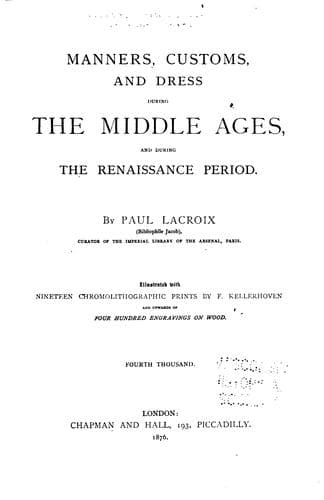
Manners, Customs, and Dress During the Middle Ages and During the Renaissance PeriodJacob, P. L.
History
Manners, Customs, and Dress During the Middle Ages and During the Renaissance Period
Jacob, P. L.
Clothing and dress; Manners and customs; Middle Ages; Renaissance
The eleventh century, during which feudal power rose to its height, was
also the period when a reaction set in of the townspeople against the
nobility. The spirit of the city revived with that of the bourgeois (a
name derived from the Teutonic word _burg_, habitation) and infused a
feeling of opposition to the system which followed the conquest of the
Teutons. "But," says M. Henri Martin, "what reappeared was not the Roman
municipality of the Empire, stained by servitude, although surrounded with
glittering pomp and gorgeous arts, but it was something coarse and almost
semi-barbarous in form, though strong and generous at core, and which, as
far as the difference of the times would allow, rather reminds us of the
small republics which existed previous to the Roman Empire."
Two strong impulses, originating from two totally dissimilar centres of
action, irresistibly propelled this great social revolution, with its
various and endless aspects, affecting all central Europe, and being more
or less felt in the west, the north, and the south. On one side, the Greek
and Latin partiality for ancient corporations, modified by a democratic
element, and an innate feeling of opposition characteristic of barbaric
tribes; and on the other, the free spirit and equality of the old Celtic
tribes rising suddenly against the military hierarchy, which was the
offspring of conquest. Europe was roused by the double current of ideas
which simultaneously urged her on to a new state of civilisation, and more
particularly to a new organization of city life.
Italy was naturally destined to be the country where the new trials of
social regeneration were to be made; but she presented the greatest
possible variety of customs, laws, and governments, including Emperor,
Pope, bishops, and feudal princes. In Tuscany and Liguria, the march
towards liberty was continued almost without effort; whilst in Lombardy,
on the contrary, the feudal resistance was very powerful. Everywhere,
however, cities became more or less completely enfranchised, though some
more rapidly than others. In Sicily, feudalism swayed over the countries;
but in the greater part of the peninsula, the democratic spirit of the
cities influenced the enfranchisement of the rural population. The feudal
caste was in fact dissolved; the barons were transformed into patricians
of the noble towns which gave their republican magistrates the old title
of consuls. The Teutonic Emperor in vain sought to seize and turn to his
own interest the sovereignty of the people, who had shaken off the yokes
of his vassals: the signal of war was immediately given by the newly
enfranchised masses; and the imperial eagle was obliged to fly before the
banners of the besieged cities. Happy indeed might the cities of Italy
have been had they not forgotten, in their prosperity, that union alone
could give them the possibility of maintaining that liberty which they so
freely risked in continual quarrels amongst one another!
Public-domain text, read in full here on John Shaqi.
Reviews
Reviews
No reviews yet
Be the first to share your thoughts on this work.
Join the Discussion
Join the discussion
Sign in to leave a comment or review.
Sign InorCreate an account