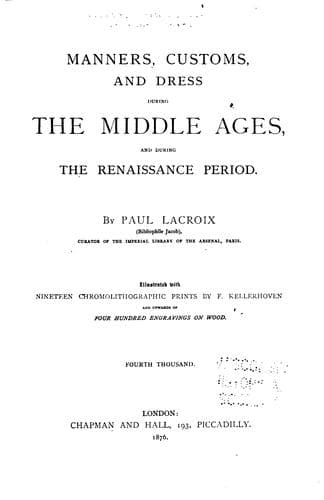
Manners, Customs, and Dress During the Middle Ages and During the Renaissance PeriodJacob, P. L.
History
Manners, Customs, and Dress During the Middle Ages and During the Renaissance Period
Jacob, P. L.
Clothing and dress; Manners and customs; Middle Ages; Renaissance
It is clear, however, that as early as the beginning of the Merovingian
race, there was much more luxury and comfort among the upper classes than
is generally supposed. All the gold and silver furniture, all the jewels,
and all the rich stuffs which the Gallo-Romans had amassed in their
sumptuous dwellings, had not been destroyed by the barbarians. The Frank
Kings had appropriated the greater part; and the rest had fallen into the
hands of the chiefs of companies in the division of spoil. A well-known
anecdote, namely, that concerning the Vase of Soissons (Fig. 41), which
King Clovis wished to preserve, and which a soldier broke with an axe,
proves that many gems of ancient art must have disappeared, owing to the
ignorance and brutality of the conquerors; although it is equally certain
that the latter soon adopted the tastes and customs of the native
population. At first, they appropriated everything that flattered their
pride and sensuality. This is how the material remains of the civilisation
of the Gauls were preserved in the royal and noble residences, the
churches, and the monasteries. Gregory of Tours informs us, that when
Frédégonde, wife of Chilpéric, gave the hand of her daughter Rigouthe to
the son of the Gothic king, fifty chariots were required to carry away all
the valuable objects which composed the princess's dower. A strange family
scene, related by the same historian, gives us an idea of the private
habits of the court of that terrible queen of the Franks. "The mother and
daughter had frequent quarrels, which sometimes ended in the most violent
encounters. Frédégonde said one day to Rigouthe, 'Why do you continually
trouble me? Here are the goods of your father, take them and do as you
like with them.' And conducting her to a room where she locked up her
treasures, she opened a large box filled with valuables. After having
pulled out a great number of jewels which she gave to her daughter, she
said, 'I am tired; put your own hands in the box, and take what you find.'
Rigouthe bent down to reach the objects placed at the bottom of the box;
upon which Frédégonde immediately lowered the lid on her daughter, and
pressed upon it with so much force that the eyes began to start out of the
princess's head. A maid began screaming, 'Help! my mistress is being
murdered by her mother!' and Rigouthe was saved from an untimely end." It
is further related that this was only one of the minor crimes attributed
by history to Frédégonde _the Terrible_, who always carried a dagger or
poison about with her.
Public-domain text, read in full here on John Shaqi.
Reviews
Reviews
No reviews yet
Be the first to share your thoughts on this work.
Elsewhere in the archive
Join the Discussion
Join the discussion
Sign in to leave a comment or review.
Sign InorCreate an account