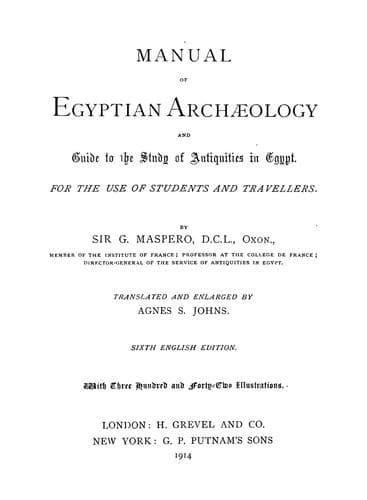
Manual of Egyptian Archaeology and Guide to the Study of Antiquities in EgyptMaspero, G. (Gaston)
History
Manual of Egyptian Archaeology and Guide to the Study of Antiquities in Egypt
Maspero, G. (Gaston)
Art -- Egypt; Egypt -- Antiquities
of the south on the right hand, and the temple of the north on the left.
The gods and their various manifestations were divided between these two
temples, according as they belonged to the northern or southern hemisphere.
This fiction of duality was carried yet further. Each chamber was divided,
in imitation of the temple, into two halves, the right half belonging to
the south, and the left half to the north. The royal homage, to be
complete, must be rendered in the temples of the south and of the north,
and to the gods of the south and of the north, and with the products of the
south and of the north. Each sculptured tableau must, therefore, be
repeated at least twice in each temple--on a right wall and on a left wall.
Amen, on the right, receives the corn, the wine, the liquids of the south;
while on the left he receives the corn, the wine, and the liquids of the
north. As with Amen, so with Maut, Khonsû, Mentû, and many other gods. Want
of space frequently frustrated the due execution of this scheme, and we
often meet with a tableau in which the products of north and south together
are placed before an Amen who represents both Amen of the south and Amen of
the north. These departures from decorative usage are, however,
exceptional, and the dual symmetry is always observed where space permits.
[Illustration: Fig. 106.--Frieze of uraei and cartouches.]
In Pharaonic times, the tableaux were not over-crowded. The wall-surface
intended to be covered was marked off below by a line carried just above
the ground level decoration, and was bounded above by the usual cornice, or
by a frieze. This frieze might be composed of uraei, or of bunches of
lotus; or of royal cartouches (fig. 106) supported on either side by divine
symbols; or of emblems borrowed from the local cult (by heads of Hathor,
for instance, in a temple dedicated to Hathor); or of a horizontal line of
dedicatory inscription engraved in large and deeply-cut hieroglyphs. The
wall space thus framed in contained sometimes a single scene and sometimes
two scenes, one above the other. The wall must be very lofty, if this
number is exceeded. Figures and inscriptions were widely spaced, and the
scenes succeeded one another with scarcely a break. The spectator had to
discover for himself where they began or ended. The head of the king was
always studied from the life, and the faces of the gods reproduced the
royal portrait as closely as possible. As Pharaoh was the son of the gods,
the surest way to obtain portraits of the gods was to model their faces
after the face of the king. The secondary figures were no less carefully
wrought; but when these were very numerous, they were arranged on two or
three levels, the total height of which never exceeded that of the
principal personages. The offerings, the sceptres, the jewels, the
vestments, the head-dresses, and all the accessories were treated with a
genuine feeling for elegance and truth. The colours, moreover, were so
Public-domain text, read in full here on John Shaqi.
Reviews
Reviews
No reviews yet
Be the first to share your thoughts on this work.
Elsewhere in the archive
Join the Discussion
Join the discussion
Sign in to leave a comment or review.
Sign InorCreate an account