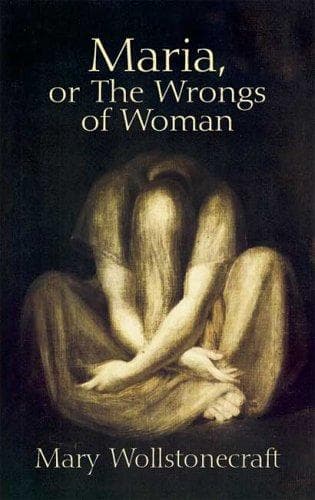
Maria; Or, The Wrongs of WomanWollstonecraft, Mary
General
Maria; Or, The Wrongs of Woman
Wollstonecraft, Mary
Autobiographical fiction; Feminist fiction; Women -- Fiction
“What a revolution took place, not only in my train of thoughts, but
feelings! I trembled with emotion—now, indeed, I was in love. Such
delicacy too, to enhance his benevolence! I felt in my pocket every
five minutes, only to feel the guinea; and its magic touch invested my
hero with more than mortal beauty. My fancy had found a basis to erect
its model of perfection on; and quickly went to work, with all the
happy credulity of youth, to consider that heart as devoted to virtue,
which had only obeyed a virtuous impulse. The bitter experience was yet
to come, that has taught me how very distinct are the principles of
virtue, from the casual feelings from which they germinate.”
CHAPTER 8
“I have perhaps dwelt too long on a circumstance, which is only of
importance as it marks the progress of a deception that has been so
fatal to my peace; and introduces to your notice a poor girl, whom,
intending to serve, I led to ruin. Still it is probable that I was not
entirely the victim of mistake; and that your father, gradually
fashioned by the world, did not quickly become what I hesitate to call
him—out of respect to my daughter.
“But, to hasten to the more busy scenes of my life. Mr. Venables and my
mother died the same summer; and, wholly engrossed by my attention to
her, I thought of little else. The neglect of her darling, my brother
Robert, had a violent effect on her weakened mind; for, though boys may
be reckoned the pillars of the house without doors, girls are often the
only comfort within. They but too frequently waste their health and
spirits attending a dying parent, who leaves them in comparative
poverty. After closing, with filial piety, a father’s eyes, they are
chased from the paternal roof, to make room for the first-born, the
son, who is to carry the empty family-name down to posterity; though,
occupied with his own pleasures, he scarcely thought of discharging, in
the decline of his parent’s life, the debt contracted in his childhood.
My mother’s conduct led me to make these reflections. Great as was the
fatigue I endured, and the affection my unceasing solicitude evinced,
of which my mother seemed perfectly sensible, still, when my brother,
whom I could hardly persuade to remain a quarter of an hour in her
chamber, was with her alone, a short time before her death, she gave
him a little hoard, which she had been some years accumulating.
“During my mother’s illness, I was obliged to manage my father’s
temper, who, from the lingering nature of her malady, began to imagine
that it was merely fancy. At this period, an artful kind of upper
servant attracted my father’s attention, and the neighbours made many
remarks on the finery, not honestly got, exhibited at evening service.
But I was too much occupied with my mother to observe any change in her
dress or behaviour, or to listen to the whisper of scandal.
Public-domain text, read in full here on John Shaqi.
Reviews
Reviews
No reviews yet
Be the first to share your thoughts on this work.
Join the Discussion
Join the discussion
Sign in to leave a comment or review.
Sign InorCreate an account