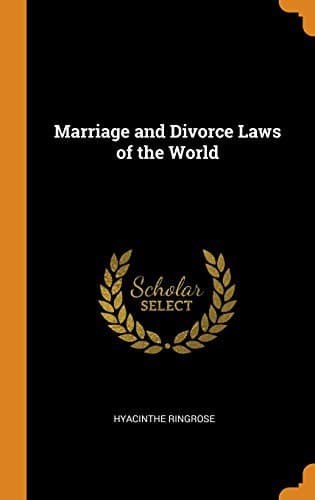
Marriage and Divorce Laws of the WorldRingrose, Hyacinthe
History
Marriage and Divorce Laws of the World
Ringrose, Hyacinthe
Divorce -- Law and legislation; Marriage law
Spain is a constitutional and hereditary monarchy, the powers of which are
defined by the fundamental law of June 30, 1876. The legislative authority
is exercised by the sovereign in conjunction with a parliamentary body
called the Cortes, which is composed of two houses, a Senate and a Chamber
of Deputies.
Spanish law is founded on the Roman law, the Gothic common law, the
National Code of 1501, and the Civil Code of 1888, with its subsequent
amendments and additions.
Spanish law is binding in the Spanish Peninsula and adjacent islands, the
Canary Islands and such African territory as is subject to Spain.
MARRIAGE.--The law recognizes two forms of marriage: the canonical, which
all who profess the Catholic religion should contract; and the civil,
which must be celebrated in the manner hereinafter stated.
Marriage is forbidden to:
1. Minors who have not obtained parental consent.
2. To a widow, during the three hundred and one days following the death
of her husband or before childbirth, if she has been left pregnant.
3. To a guardian and his or her descendants, with respect to persons who
are the wards of such guardian until the ending of the guardianship, and a
proper accounting has been rendered by the guardian. An exception to this
rule exists when the father of the ward has in his will or in a public
instrument expressly authorized such a marriage.
AGE.--A male cannot marry until he has completed his fourteenth year of
age; a female until she has completed her twelfth year.
Marriage contracted by persons under puberty shall, nevertheless, be _ipso
facto_ made legal if a day after having arrived at the legal age of
puberty, the parties continue to live together without bringing a suit to
set aside the marriage, or if the female becomes pregnant before the legal
age, or before the institution of a suit for annulment.
Persons who are not in the full exercise of their reasoning faculties
cannot contract marriage.
The law forbids the marriage of all those who suffer from absolute or
relative impotency.
Priests and all other persons bound by a solemn pledge of celibacy in the
approved canonical manner are forbidden to contract marriage, unless they
have first received the necessary canonical dispensation.
Persons already lawfully married cannot contract a new marriage.
CONSANGUINITY AND AFFINITY.--The following persons cannot contract
marriage between themselves:
1. The ascendants and descendants by legitimate or illegitimate blood or
affinity.
2. Collaterals by legitimate consanguinity up to and including the fourth
degree.
3. Collaterals by legitimate affinity up to and including the fourth
degree.
4. Collaterals by natural consanguinity or affinity up to and including
the second degree.
5. The adopting father or mother and the adopted child; the latter and the
surviving spouse of the adoptees, and the adopters and the surviving
spouse of the adopted.
Public-domain text, read in full here on John Shaqi.
Reviews
Reviews
No reviews yet
Be the first to share your thoughts on this work.
Elsewhere in the archive
Join the Discussion
Join the discussion
Sign in to leave a comment or review.
Sign InorCreate an account