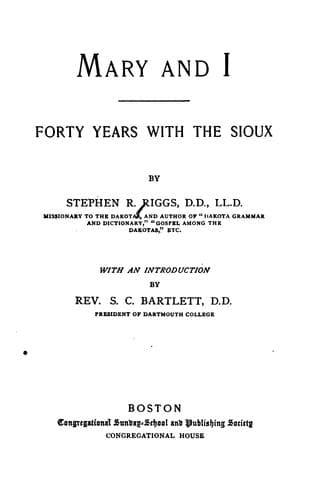
Mary and I: Forty Years with the Sioux — John Shaqi
Mary and I: Forty Years with the SiouxRiggs, Stephen Return
History
Mary and I: Forty Years with the Sioux
Riggs, Stephen Return
Dakota Indians -- Missions; Riggs, Stephen Return, 1812-1883
To learn an unwritten language, and to reduce it to a form that can be
seen as well as heard, is confessedly a work of no small magnitude.
Hitherto it has seemed to exist only in sound. But it has been, all
through the past ages, worked out and up by the forges of human
hearts. It has been made to express the lightest thoughts as well as
the heart-throbs of men and women and children in their generations.
The human mind, in its most untutored state, is God's creation. It may
not stamp purity nor even goodness on its language, but it always, I
think, stamps it with the deepest philosophy. So far, at least,
language is of divine origin. The unlearned Dakota may not be able to
give any definition for any single word that he has been using all his
life-time,--he may say, "It means that, and can't mean any thing
else,"--yet, all the while, in the mental workshop of the people,
unconsciously and very slowly it may be, but no less very surely,
these words of air are newly coined. No angle can turn up, but by and
by it will be worn off by use. No ungrammatical expression can come in
that will not be rejected by the best thinkers and speakers. New words
will be coined to meet the mind's wants; and new forms of expression,
which at the first are bungling descriptions only, will be pared down
and tucked up so as to come into harmony with the living language.
But it was no part of our business to make the Dakota language. It was
simply the missionary's work to report it faithfully. The system of
notation had in the main been settled upon before Mary and I joined
the mission. It was, of course, to be phonetic, as nearly as possible.
The English alphabet was to be used as far as it could be. These were
the principles that guided and controlled the writing of Dakota. In
their application it was soon found that only five pure vowel sounds
were used. So far the work was easy. Then it was found that x and v
and r and g and j and f and c, with their English powers, were not
needed. But there were four _clicks_ and two _gutturals_ and a _nasal_
that must in some way be expressed. It was then, even more than now, a
matter of pecuniary importance that the language to be printed should
require as few new characters as possible. And so n was taken to
represent the nasal; q represented one of the clicks; g and r
represented the gutturals; and c and j and x were used to represent
ch, zh, and sh. The other clicks were represented by marked letters.
Since that time, some changes have been made: x and r have been
discarded from the purely Dakota alphabet. In the Dakota grammar and
dictionary, which was published fifteen years afterward, an effort was
made to make the notation philosophical, and accordant with itself.
The changes which have since been adopted have all been in the line of
the dictionary.
Public-domain text, read in full here on John Shaqi.
Reviews
Reviews
No reviews yet
Be the first to share your thoughts on this work.
Join the Discussion
Join the discussion
Sign in to leave a comment or review.
Sign InorCreate an account