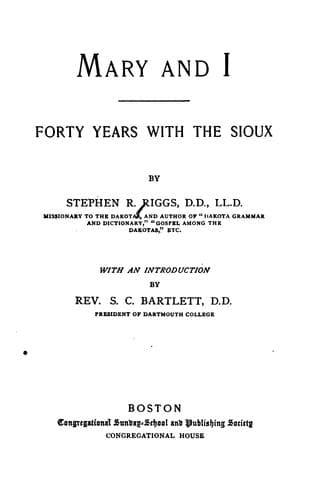
Mary and I: Forty Years with the SiouxRiggs, Stephen Return
History
Mary and I: Forty Years with the Sioux
Riggs, Stephen Return
Dakota Indians -- Missions; Riggs, Stephen Return, 1812-1883
When we missionaries had gathered and expressed and arranged the words
of this language, what had we to put into it, and what great gifts had
we for the Dakota people? What will you give me? has always been their
cry. We brought to them the Word of Life, the Gospel of Salvation
through faith in Jesus Christ our Lord, as contained in the Bible. Not
to preach Christ to them only, that they might have life, but to
engraft his living words into their living thoughts, so that they
might grow into his spirit more and more, was the object of our
coming. The labor of writing the language was undertaken as a means to
a greater end. To put God's thoughts into their speech, and to teach
them to read in their own tongue the wonderful works of God, was what
brought us to the land of the Dakotas. But they could not appreciate
this. Ever and anon came the question, What will you give me? And so,
when we would proclaim the "old, old story" to those proud Dakota men
at Lac-qui-parle, we had to begin with kettles of boiled pumpkins,
turnips, and potatoes. The bread that perisheth could be
appreciated--the Bread of Life was still beyond their comprehension.
But by and by it was to find its proper nesting-place.
It was very fortunate for the work of education among the Dakotas that
it had such a staunch and influential friend as Joseph Renville, Sr.,
of Lac-qui-parle. It was never certainly known whether Mr. Renville
could read his French Bible or not. But he had seen so much of the
advantages of education among the white people, that he greatly
desired his own children should learn to read and write, both in
Dakota and English, and through his whole life gave his influence in
favor of Dakota education. Sarah Poage, afterward Mrs. G. H. Pond, had
come as a teacher, and had, from their first arrival at Lac-qui-parle,
been so employed. Mr. Renville had four daughters, all of them young
women, who had, with some other half-breeds, made an English class.
They had learned to read the language, but understood very little of
it, and were not willing to speak even what they understood. All
through these years the teaching of English, commenced at the
beginning of our mission work, although found to be very difficult and
not producing much apparent fruit, has never been abandoned. But for
the purposes of civilization, and especially of Christianization, we
have found culture in the native tongue indispensable.
To teach the classes in English was in Mary's line of life. She at
once relieved Miss Poage of this part of her work, and continued in
it, with some intervals, for several years. Often she was greatly
tried, not by the inability of her Dakota young lady scholars, but by
their unwillingness to make such efforts as to gain the mastery of
English.
Public-domain text, read in full here on John Shaqi.
Reviews
Reviews
No reviews yet
Be the first to share your thoughts on this work.
Join the Discussion
Join the discussion
Sign in to leave a comment or review.
Sign InorCreate an account