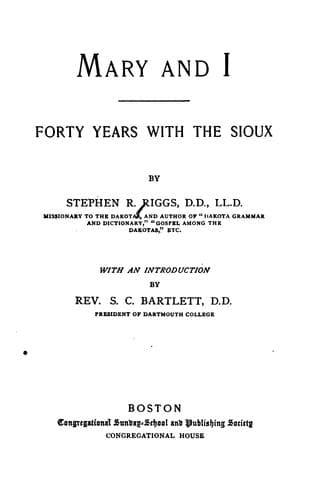
Mary and I: Forty Years with the SiouxRiggs, Stephen Return
History
Mary and I: Forty Years with the Sioux
Riggs, Stephen Return
Dakota Indians -- Missions; Riggs, Stephen Return, 1812-1883
During this first year that Mary and I spent in the Dakota country,
there were coming to us continually new experiences. One of the most
common, and yet one of the most thrilling and abiding, was in the
birth of our first-born. In motherhood and fatherhood are found large
lessons in life. The mother called her first-born child Alfred
Longley, naming him for a very dear brother of hers. The Dakotas named
this baby boy of ours Good Bird (_Zitkadan Washtay_). They said that
it was a good name. In those days it was a habit with them to give
names to the white people who came among them. Dr. Williamson they
called _Payjehoota Wechasta_--Medicine man, or, more literally,
Grass-root man--that is, _Doctor_. To Mr. G. H. Pond they gave the
name _Matohota_, Grizzly-bear. Mr. S. W. Pond was _Wamdedoota_,
Red-eagle. To me they gave the name of _Tamakoche_, His country. They
said some good Dakota long ago had borne that name. To Mary they gave
the name of _Payuha_. At first they gutturalized the h, which made it
mean _Curly-head_--her black hair did curl a good deal; but afterward
they naturalized the h, and said it meant _Having-a-head_.
The winter as it passed by had other lessons for us. For me it was
quite a chore to cut and carry up wood enough to keep our somewhat
open upper room cosey and comfortable. Mary had more ambition than I
had to get native help. She had not been accustomed to do a day's
washing. It came hard to her. The other women of the mission preferred
to wash for themselves rather than train natives to do it. And indeed,
at the beginning, that was found to be no easy task. For, in the first
place, Dakota women did not wash. Usually they put on a garment and
wore it until it rotted off. This was pretty much the rule. No good,
decent woman could be found willing to do for white people what they
did not do for themselves. We could hire all the first women of the
village to hoe corn or dig potatoes, but not one would take hold of
the wash-tub. And so it was that Mary's first washer-women were of the
lowest class, and not very reputable characters. But she persevered
and conquered. Only a few years had passed when the wash-women of the
mission were of the best women of the village. And the effort proved a
great public benefaction. The gospel of soap was indeed a necessary
adjunct and outgrowth of the Gospel of Salvation.
"Dec. 13.
Public-domain text, read in full here on John Shaqi.
Reviews
Reviews
No reviews yet
Be the first to share your thoughts on this work.
Join the Discussion
Join the discussion
Sign in to leave a comment or review.
Sign InorCreate an account