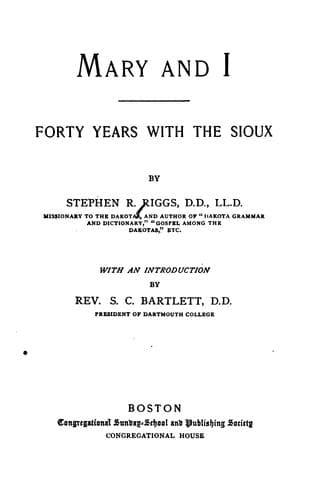
Mary and I: Forty Years with the SiouxRiggs, Stephen Return
History
Mary and I: Forty Years with the Sioux
Riggs, Stephen Return
Dakota Indians -- Missions; Riggs, Stephen Return, 1812-1883
It appears that during the winter some rumors of peace visits from the
Ojibwas had reached the Dakotas, so that this hunting party were
somewhat prepared to meet Ojibwas who should come with this announced
purpose. The half-dozen teepees had divided. Mr. Pond was with Round
Wind, who had removed from the three teepees that remained. On
Thursday evening there came Hole-in-the-day, an Ojibwa chief, with ten
men. They had come to smoke the peace-pipe, they said. The three
Dakota tents contained but three men and ten or eleven women and
children. But, while starving themselves, they would entertain their
visitors in the most royal style. Two dogs were killed and they were
feasted, and then all lay down to rest. But the Ojibwas were false.
They arose at midnight and killed their Dakota hosts. In the morning
but one woman and a boy remained alive of the fourteen in the three
teepees the night before, and the boy was badly wounded. It was a
cowardly act of the Ojibwas, and one that was terribly avenged
afterward. When Mr. Pond had helped to bury the dead and mangled
remains of these three families, he started for home, and was the
first to bring the sad news to their friends at Lac-qui-parle. To him
quite an experience was bound up in those two weeks, and the marvel
was, why he was not then among the slain. To Mary and me it opened a
whole store-house of instruction, as we listened to the wail of the
whole village, and especially when the old women came with dishevelled
heads and ragged clothes, and cried and sang around our house, and
_begged in the name of our first-born_. We discovered all at once the
power of a name. And if an earthly name has such power, much more the
Name that is above every name--much more the Name of the Only Begotten
of the heavenly Father.
* * * * *
Lac-qui-parle was in those days much shut out from the great world. We
were two hundred miles away from our post-office at Fort Snelling. We
seldom received a letter from Massachusetts or Ohio in less than three
months after it was written. Often it was much longer, for there were
several times during our stay at Lac-qui-parle when we passed three
months, and once five months, without a mail. We used to pray that the
mail would not come in the evening. If it did, good-by sleep! If it
came in the early part of the day, we could look it over and become
quieted by night. Our communication with the post-office was generally
through the men engaged in the fur-trade. Some of them had no sympathy
with us as missionaries, but they were ever willing to do us a favor
as men and Americans. Sometimes we sent and received our mail by
Indians. That was a very costly way. The postage charged by the
government--although it was then twenty-five cents on a letter--was no
compensation for a Dakota in those days. It is fortunate for them that
they have learned better the value of work.
Public-domain text, read in full here on John Shaqi.
Reviews
Reviews
No reviews yet
Be the first to share your thoughts on this work.
Elsewhere in the archive
Join the Discussion
Join the discussion
Sign in to leave a comment or review.
Sign InorCreate an account