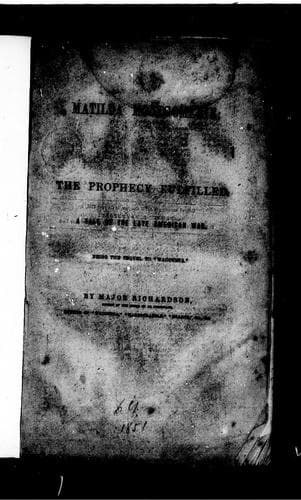
Matilda Montgomerie; Or, The Prophecy FulfilledRichardson, Major (John)
History
Matilda Montgomerie; Or, The Prophecy Fulfilled
Richardson, Major (John)
United States -- History -- War of 1812 -- Fiction
"It will hardly be necessary to deny the justice of such an imputation
to Major Montgomerie," remarked the General, with a smile, "especially
after having disavowed the opinion as his own. The charge is too absurd
for serious contradiction--yet we are not altogether ignorant that such
an impression has gone abroad."
"Few of the more enlightened of our citizens give into the belief," said
the Major; "still it will give me especial pleasure to have it in my
power to contradict the assertion from the lips of General Brock
himself."
"That we have entered into a treaty of alliance with the Indians,"
observed Colonel D'Egville, "is most certainly true; but it is an
alliance wholly defensive. I must further observe, that in whatever
light the policy of the Government of the United States in its relations
with the Indians, may be privately viewed, we are, under all
circumstances, the last people in the world who should condemn it as
injurious to our public interests, since it has been productive of
results affecting the very existence of these provinces. Had the
American Government studied conciliation rather than extension of
territory, it is difficult to say to what side the great body of the
Indians would, in the impending struggle, have leaned. The possibility
of some such event as the present had not only been foreseen, but
anticipated. It has long been obvious to us that the spirit of
acquisition manifested by the United States, would not confine itself to
its customary channels; but on the contrary, that, not contented with
the appropriation of the hunting grounds of the Indians, it would
finally extend its views to Canada. Such a crisis has long been provided
against. Presents, to a large amount, have certainly been distributed
among the Indians, and not only this, but every courtesy, consistent at
once with our dignity and our interest, has been shown to them. You have
seen, for instance," continued he with a smile, "my three friends who
have just left the room; they are not exactly the happiest specimens of
Indian grace, but they have great weight in the council, and are the
leading men in the alliance to which you alluded, although not wholly
for the same purpose. In the wars of Pontiac--and these are still fresh
in the recollection of certain members of my own family--the English
commanders, with one or two exceptions, brought those disasters upon
themselves. Forgetting that the Indians were a proud people, whom to
neglect was to stir into hatred, they treated them with indifference, if
not with contempt; and dearly did they pay the penalty of their fault.
As we all know, they, with only one exception, were destroyed. In their
fall expired the hostility they themselves had provoked, and time had
wholly obliterated the sense of injustice from the minds of the several
nations. Were we then, with these fearful examples yet fresh in our
recollection, to fall into a similar error? No: a course of conciliation
Public-domain text, read in full here on John Shaqi.
Reviews
Reviews
No reviews yet
Be the first to share your thoughts on this work.
Join the Discussion
Join the discussion
Sign in to leave a comment or review.
Sign InorCreate an account