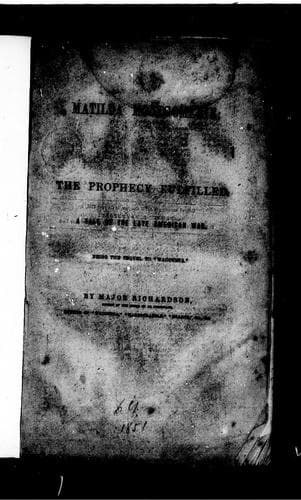
Matilda Montgomerie; Or, The Prophecy FulfilledRichardson, Major (John)
History
Matilda Montgomerie; Or, The Prophecy Fulfilled
Richardson, Major (John)
United States -- History -- War of 1812 -- Fiction
"Nay, Major Montgomerie," observed the General, "it would indeed be
exacting too much to require that we should offer ourselves unresisting
victims to your Government; and what but self-immolation would it be to
abstain from the only means by which we can hope to save these
threatened Provinces? Colonel D'Egville has just said that, with the
Indians opposed to us, Canada would fall. I go farther, and aver that,
without the aid of the Indians, circumstanced as England now is, Canada
must be lost to us. It is a painful alternative, I admit, for that a
war, which is not carried on with the conventional courtesies of
civilized belligerent nations, is little suited to our taste, you will
do us the justice to believe; but by whom have we been forced into the
dilemma? Had we been guilty of rousing the Indian spirit against you,
with a view to selfish advantage; or had we in any way connived at the
destruction of your settlements, from either dread or jealousy of your
too close proximity, then should we have deserved all the odium of such
conduct. But this we unequivocally deny.
"I would ask you, on the other hand, if you are aware of the great
exertions made by your Government, to induce them to take an active part
in this very war. If not, I can acquaint you that several of the chiefs,
now here, have been strongly urged to declare against us; and, not very
long since, an important council was held among the several tribes,
wherein some few, who had been won over by large bribes, discussed the
propriety of deserting the British cause, in consideration of advantages
which were promised them by the United States. These of course were
overruled by the majority, who expressed the utmost indignation at the
proposal; but the attempt to secure their active services was not the
less made. We certainly have every reason to congratulate ourselves on
its failure."
"This certainly partakes of the _argumentum ad hominem_," said the
Major, good humoredly; "I do confess, I am aware that, since the idea of
war against England was first entertained, great efforts have been made
to attach the Indians to our interests; and in all probability, had any
other man than Tecumseh presided over their destinies, our Government
would have been successful. I however, for one, am no advocate for their
employment on either side; for it must be admitted they are a terrible
and a cruel enemy, sparing neither age nor sex."
"Again, Major," returned the General, "do we shield ourselves under our
former plea--that, as an assailed party, we have a right to avail
ourselves of whatever means of defence are within our reach. One of two
things--either we must retain the Indians, who are bound to us in one
common interest, or we must, by discarding them, quietly surrender the
Canadas to your armies. Few will be Quixotic enough to hesitate as to
which of the alternatives we should adopt."
Public-domain text, read in full here on John Shaqi.
Reviews
Reviews
No reviews yet
Be the first to share your thoughts on this work.
Join the Discussion
Join the discussion
Sign in to leave a comment or review.
Sign InorCreate an account