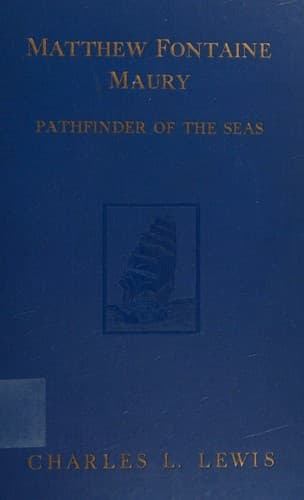
Matthew Fontaine Maury, the Pathfinder of the SeasLewis, Charles Lee
History
Matthew Fontaine Maury, the Pathfinder of the Seas
Lewis, Charles Lee
Maury, Matthew Fontaine, 1806-1873
As to the contents and general scope of his book, Maury wrote in
the introduction, “Under this term will be included a philosophical
account of the winds and currents of the sea; of the circulation of
the atmosphere and ocean; of the temperature and depth of the sea; of
the wonders that are hidden in its depths; and of the phenomena that
display themselves at its surface. In short, I shall treat of the
economy of the sea and its adaptations—of its salts, its waters, its
climates, and its inhabitants, and of whatever there may be of general
interest in its commercial uses or industrial pursuits, for all such
things pertain to its Physical Geography”. It contained also a number
of illustrative plates, among which was the first bathymetric map ever
made of the North Atlantic Ocean, with contour-lines drawn in at 1000,
2000, 3000, and 4000 fathoms.
Some idea of the nature of the book and of Maury’s peculiar style can
be best secured by the consideration of some selections taken from
it here and there. Those quoted below are, of course, of the nature
of “purple patches”, for it must not be supposed that there are no
dry and uninteresting passages in the book; but they are fairly
representative and will probably serve the purpose intended. Maury was
the first scientist to make a careful study of the Gulf Stream, and
the first chapter of his “Physical Geography of the Sea” is devoted
to this mighty ocean current. The reader’s interest is gained and
his imagination is excited at once by these opening sentences: “There
is a river in the ocean. In the severest droughts it never fails, and
in the mightiest floods it never overflows. Its banks and its bottom
are of cold water, while its current is of warm. The Gulf of Mexico
is its fountain, and its mouth is in the Arctic Seas. It is the Gulf
Stream. There is in the world no other such majestic flow of waters.
Its current is more rapid than the Mississippi or the Amazon, and its
volume more than a thousand times greater”.
In the chapter on the “Influence of the Gulf Stream upon Climates” is
the following striking passage on whales and other animals of the sea:
“Now, the Western Islands is the great place of resort for whales: and
at first there is something curious to us in the idea that the Gulf
of Mexico is the harvest-field, and the Gulf Stream the gleaner which
collects the fruitage planted there, and conveys it thousands of miles
off to the hungry whale at sea. But how perfectly in unison is it with
the kind and providential care of that great and good Being which feeds
the young ravens when they cry, and caters for the sparrow....
Public-domain text, read in full here on John Shaqi.
Reviews
Reviews
No reviews yet
Be the first to share your thoughts on this work.
Join the Discussion
Join the discussion
Sign in to leave a comment or review.
Sign InorCreate an account