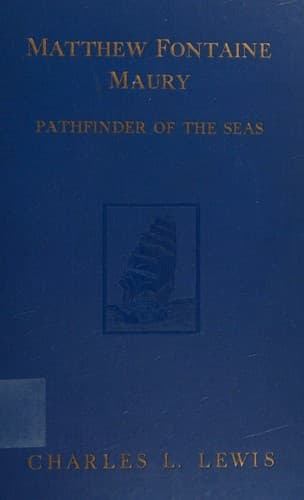
Matthew Fontaine Maury, the Pathfinder of the SeasLewis, Charles Lee
History
Matthew Fontaine Maury, the Pathfinder of the Seas
Lewis, Charles Lee
Maury, Matthew Fontaine, 1806-1873
“The inhabitants of the ocean are as much the creatures of climate as
are those of the dry land; for the same Almighty hand, which decked
the lily and cares for the sparrow, fashioned also the pearl and feeds
the great whale, and adapted each to the physical conditions by which
His providence has surrounded it. Whether of the land or the sea, the
inhabitants are all His creatures, subjects of His laws, and agents of
His economy. The sea, therefore, we may safely infer, has its offices
and duties to perform; so, may we infer, have its currents, and so,
too, its inhabitants; consequently, he who undertakes to study its
phenomena must cease to regard it as a waste of waters. He must look
upon it as a part of that exquisite machinery by which the harmonies
of nature are preserved, and then he will begin to perceive the
developments of order and the evidences of design; these make it a most
beautiful and interesting subject for contemplation”.
This idea of divine order and design occurs again and again in the book
like the motive in a piece of music; in fact, Maury, though he did not
formally enter the church until late in life, was a very religious
man and well read in the Bible, quotations from which appear in his
writings by the dozen. He had very definite ideas about the relation
between science and the Bible, and declared that it was his rule never
to forget who was the Author of the great volume which Nature spreads
out before men, and always to remember that the same Being was the
author of the book which revelation holds forth for contemplation. It
was his opinion that, though the works were entirely different, their
records were equally true, and that when they bear upon the same point,
as they occasionally do, it would be impossible for them to contradict
each other. If the two cannot be reconciled, the fault therefore is in
man’s weakness and blindness in interpreting them aright.
Public-domain text, read in full here on John Shaqi.
Reviews
Reviews
No reviews yet
Be the first to share your thoughts on this work.
Join the Discussion
Join the discussion
Sign in to leave a comment or review.
Sign InorCreate an account