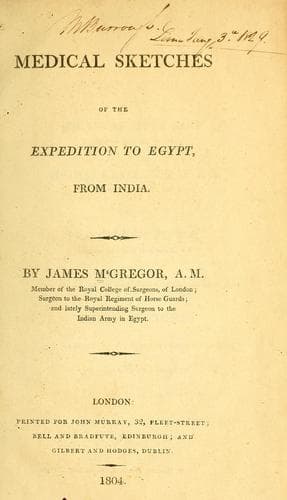
Medical Sketches of the Expedition to Egypt, from India — John Shaqi
Medical Sketches of the Expedition to Egypt, from IndiaMcGrigor, James, Sir
History
Medical Sketches of the Expedition to Egypt, from India
McGrigor, James, Sir
Great Britain. Army -- Sanitary affairs; Medicine, Military
In Egypt I found that all the above-quoted remarks held good;
in particular that relating to heat. Though the degree of it be
very considerably increased, I believe that, unless combined with
intemperance, or some other cause, it very rarely is the exciting cause
of disease. At Kossier, and in crossing the desert, the degree of heat
was very great, and both the officers and men, from Madras, as well as
Bengal, complained that it was more insupportable than they had ever
felt it in the hottest seasons. Yet, at the above period, the army
enjoyed an uncommon degree of health, though they necessarily were much
exposed to the sun: but their minds as well as their bodies were at
this time exercised. Not only on crossing the desert, but for some time
after we reached the Nile at Ghenné, we all thought that we were in the
neighbourhood of a division of the French army, and the Indian army was
for some time kept in the constant hopes of being engaged.
That simple moisture is noxious, the situation of the 61st regiment, in
the Pharos, shewed; and that moist exhalations from marshes were active
as causes of the diseases which prevailed, from the arrival of the army
at Rhoda till their departure from El Hammed, the journal gives abundant
proof.
We received still farther confirmation of the very great influence which
intemperance has as a cause of disease. We had demonstration how very
little spirits are required, in a hot climate, to enable the soldier to
bear fatigue, and how necessary a regular diet is.
At Ghenné, and on the voyage down the Nile, (on account of the difficulty
of at first conveying it across the desert,) the men had no spirits
delivered out to them; and I am convinced that, from this, not only did
they not suffer, but that it even contributed to the uncommon degree of
health which they at this time enjoyed. From two germs, or boats, the
soldiers one day strayed into a village, where the Arabs gave them as
much of the spirit which they distil from the juice of the date-tree, as
induced a kind of furious intoxication. It was remarked, that, for three
months after, a considerable number of these men were in the hospitals.
On the causes of the plague I do not mean to dwell. I may just mention,
that, after seeing the first cases which occurred in the Indian army,
and attentively studying the histories of some of the cases which
subsequently appeared, it struck me that there were many points of
resemblance between this disease and the destructive fever of the West
Indies, which, some years ago, I saw a good deal of in several of the
islands there. I would by no means, however, have it implied that I
consider the diseases as the same.
One of our medical gentlemen persevered in an opinion that the plague
was not contagious. He made the first, and we sincerely hope the last,
experiment of the kind to determine this question. Dr Whyte fell a victim
to his own temerity.
Public-domain text, read in full here on John Shaqi.
Reviews
Reviews
No reviews yet
Be the first to share your thoughts on this work.
Join the Discussion
Join the discussion
Sign in to leave a comment or review.
Sign InorCreate an account