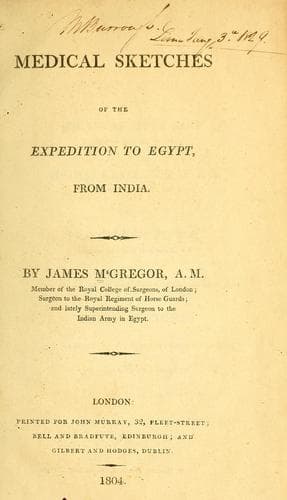
Medical Sketches of the Expedition to Egypt, from IndiaMcGrigor, James, Sir
History
Medical Sketches of the Expedition to Egypt, from India
McGrigor, James, Sir
Great Britain. Army -- Sanitary affairs; Medicine, Military
“On looking over the returns, and observing the proportional sickness of
different periods, a periodical increase was very striking. The eight
or ten days that followed the payment of the men, on the twenty-fourth
of every month, regularly produced much sickness. The soldier’s pay in
India, as in England, and perhaps every where else, allow him at times
to indulge in excess. He is most amply supplied with meat and bread, and
generally he has a portion of vegetables; but the allowance of spirits
issued to him is too great. In the dry season it is a quarter of a
pint daily, and in the rainy months it is double this quantity. As the
price of arrack is low, the soldier very often procures as much as he
can use; besides which, he has often access to farrey, or toddey, the
fermented juice of the cocoa-nut tree. Some degree of intoxication and
intemperance, in a corps in India, is perhaps unavoidable. Intemperance
has hitherto always appeared as a principal cause of the diseases which
have prevailed.
“The difference, in point of health, between the hot and the cold, the
dry and the rainy, months is striking. For the last eighteen months, in
the hot season, the men had much duty. They were daily marched two miles
to the fort of Bombay; while there, they were much exposed to the sun
on the garrison-duty; and, in the heat of the next day, were marched
back to their barracks on the island of Colabah. Yet it appears, by the
accompanying tables, that the hot months were the most healthy by far. If
heat be very noxious, something in this instance obviated its effects.
Was this exercise?
“The first year after the arrival of the 88th regiment, in India, they
suffered considerably. During the month after that on which the monsoon
set in, one hundred and forty, or more than one fourth of the corps, were
ill of hepatitis or dysentery. In the second year of the regiment being
in India, only seventy were admitted into the hospital in the course
of the same month, and this number was not quite one tenth of the then
strength of the corps. Here, then, we appear to have gained considerably
by being one year inured to the climate.”
Public-domain text, read in full here on John Shaqi.
Reviews
Reviews
No reviews yet
Be the first to share your thoughts on this work.
Join the Discussion
Join the discussion
Sign in to leave a comment or review.
Sign InorCreate an account