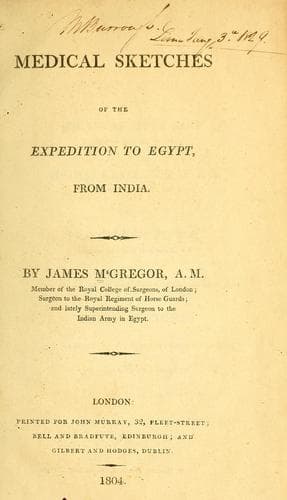
Medical Sketches of the Expedition to Egypt, from IndiaMcGrigor, James, Sir
History
Medical Sketches of the Expedition to Egypt, from India
McGrigor, James, Sir
Great Britain. Army -- Sanitary affairs; Medicine, Military
This is to be ascribed entirely to the very liberal policy of the great
character at the head of affairs in India, and to the gallant general
selected to command on this expedition. It was the governor-general’s
order, that every convenience and comfort, that might conduce to the
health of the soldier, should be most amply provided. In consequence of
this, a sufficiency of tonnage, and that calculated for a warm climate,
was procured. Large, lofty, and roomy, ships were fitted up, and the
greatest care was taken to embark only such as were in perfect health.
The transports were liberally provided with every requisite or comfort
for a long voyage: the quality of the water was particularly attended to.
Besides a large stock of fresh provisions, vegetables of every kind were
shipped. There was a large stock of potatoes, of onions, bread-fruit,
pickled vegetables, of tea, rice, and pepper, which were regularly served
out to all. Besides these, for the sick there was provided a large stock
of wines, of fermented liquors, and of every other comfort.
To the very liberal manner in which the transports were fitted up, and
to the regulations established in every transport of the fleet, which
were rigorously enforced, is undoubtedly owing the very healthy state in
which most corps remained, for half a year, on ship-board; and that, on
landing, they were fit to march on any service.
At Bombay there was, at first, a scarcity of shipping. One ship sailed
thence much crouded; and, in a three-weeks passage to Ceylon, those
on-board suffered much: there occurred much sickness and several deaths.
On their arrival at the island of Ceylon, Mr North immediately ordered
two more vessels for the troops with which this vessel (the Minerva) was
crouded. The good effects of this measure struck all: thereafter, during
a three-months passage to Kossier, there died not a man in the Minerva.
The clothing of the Indian army conduced much, in our opinion, to
their healthiness. They landed with their white cotton dresses, which
were admirably adapted to the warm season in which we came to Egypt;
favourable to cleanliness; and, by consequence, to the exclusion of
pestilential contagion.
From the time of the army first landing at Kossier, in every situation
where it could be done, bathing was enjoined throughout the army. In
every corps it was regularly done under the inspection of a commissioned
officer, and any neglect of cleanliness was most severely punished.
In any country or climate, attention to cleanliness will be found a
principal means of preserving the health of troops; but, in Egypt, where
contagion was lurking in every corner, it became indispensably necessary.
In the cold season, and while we were in Lower Egypt, warm comfortable
clothing and bedding were provided, not only for every soldier or Sepoy,
but likewise for the women, children, and all the numerous followers of
the army.
Public-domain text, read in full here on John Shaqi.
Reviews
Reviews
No reviews yet
Be the first to share your thoughts on this work.
Join the Discussion
Join the discussion
Sign in to leave a comment or review.
Sign InorCreate an account