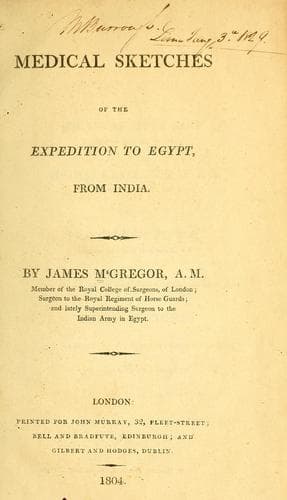
Medical Sketches of the Expedition to Egypt, from IndiaMcGrigor, James, Sir
History
Medical Sketches of the Expedition to Egypt, from India
McGrigor, James, Sir
Great Britain. Army -- Sanitary affairs; Medicine, Military
The simple diet of the Hindoo is well suited to a warm climate. It is
seldom more than rice with aromatics, or clarified butter with a kind of
pea, to which the luxury of a little salt-fish, of preserved tamarinds,
or some fresh fruit, is occasionally added. As far as it could be done,
the Europeans were made to conform to this diet; and we are convinced
that it was with much advantage to them. The light wines of the Greek
islands were issued to the Europeans in the warm season; but in the cold
they got spirits.
In the cold season it was found necessary to make some change in the
diet of the Sepoys. In the month of January they suffered so much from
the severity of the weather, and a climate very unlike their own, that a
portion of animal food, as well as of wine, was ordered to be issued to
them.
The prejudices of country, religion, and of the different casts of
Gentoos, were first overcome in the Bombay regiments. At length, the
most austere yielded; and, finally, even the severe Brahmin, as well as
the rigid Mussulman, gave way to the necessity imposed by their situation
in a foreign country.
The length of time, which most corps had been in a warm climate,
deserves to be mentioned, as a cause of the health of the Indian Army in
Egypt, till attacked by the endemic diseases of the country. No corps
in the army had been less than two years in a warm climate. During the
late war, the value of the Cape of Good Hope, to us, was often felt
and acknowledged in India. After being at this healthy settlement and
there seasoned to a warm climate, the 80th, 84th, and 86th, regiments
and the Scotch brigade, landed in India, in an effective state, never
before witnessed with European troops in that country. This fact is not
undeserving public consideration.
The fact cannot be too often repeated or too generally known, that
nothing conduces more to the health of a corps, than the preserving a
good internal economy in it. A good commanding officer has, in general,
a healthy regiment. Every thing can be done in the prevention of
disease; but, unfortunately, very often, little in the treatment when it
supervenes.
One point remains still, and I know no fitter place to introduce it than
here.
It has been mentioned, that liver complaints rarely recovered in Egypt,
and, likewise, that cases of hepatitis and flux, which, in India, had
long remained obstinate, here yielded of themselves and without medicine.
This fact leads me to the suggestion of a measure, which, I conceive,
would save many useful lives. It is, whenever a case of fever, dysentery,
or liver complaint, in India, is obstinate, or continues for a long time
on the reports, to send such cases to sea or to Europe.
Public-domain text, read in full here on John Shaqi.
Reviews
Reviews
No reviews yet
Be the first to share your thoughts on this work.
Join the Discussion
Join the discussion
Sign in to leave a comment or review.
Sign InorCreate an account