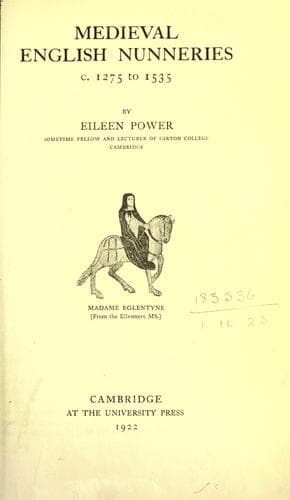
Medieval English Nunneries c. 1275 to 1535Power, Eileen
History
Medieval English Nunneries c. 1275 to 1535
Power, Eileen
Convents -- England; Monastic and religious life of women -- History
In another letter she mentions a saying of Master Harper, that from the
good report he has heard of her, he would rather admit her without a groat
than others who offer money; but her conscientious scruples were not
rewarded with St Helen's, though she almost immediately obtained an
appointment as prioress at Little Marlow, and on the dissolution of that
house among the lesser monasteries, received and held for a brief space
the great Abbey of Malling[171]. It is true that these instances of simony
and of the use of influence belong to the last degenerate years of the
monasteries in England. But cases hardly less serious undoubtedly occurred
at an early date. The gross venality of the papal _curia_[172], even in
the early thirteenth century, is not a very happy omen for the behaviour
of private patrons; smaller folk than the Pope could summon a wretched
abbot "Amice, ut offeras"; nor was it only abbots who thus bought
themselves into favour. The thirteenth century jurist Pierre Du Bois,
whose enlightened plans for the better education of women included the
suppression of the nunneries and the utilisation of their wealth to form
schools or colleges for girls, mentioned the reception of nuns for money
and rents, by means of compacts (i.e. the dowry system) and the election
of abbesses and prioresses by the same illicit bargains, as among the
abuses practised in nunneries[173].
Once having been installed, the head of a house held office until she
died, resigned or was deprived for incompetence or for ill behaviour.
Sometimes prioresses continued to hold office until a very great age, as
did Matilda de Flamstead, Prioress of Sopwell, who died in 1430 aged
eighty-one, having lived in the rules of religion for over sixty
years[174]. But the cases (quoted below) of the prioresses of St Michael's
Stamford and of Gracedieu prove that an aged and impotent head was bad for
the discipline of the house, and it appears that a prioress who was too
old or in too weak health to fulfil her arduous duties, was often allowed
to resign or was relieved of her office[175]. Sometimes an ex-superior
continued to live a communal life as an ordinary nun, under her successor,
but sometimes she was granted a special room and a special allowance of
food and attendance. In some houses certain apartments were reserved for
the occupation of a retired superior. Sir Thomas Willoughby, writing to
Cromwell on behalf of his sister-in-law, who had resigned her office as
Abbess of Malling, begs that she may
have your letter to my lady abbess of Malling (her successor), that
she at your contemplation will be so good to her as to appoint her
that room and lodging within the said monastery that she and other of
her predecessors that hath likewise resigned hath used to have, and as
she had herself a little space, or else some other meet and convenient
lodging in the same house[176].
Public-domain text, read in full here on John Shaqi.
Reviews
Reviews
No reviews yet
Be the first to share your thoughts on this work.
Join the Discussion
Join the discussion
Sign in to leave a comment or review.
Sign InorCreate an account