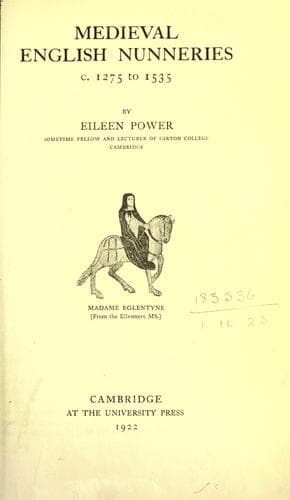
Medieval English Nunneries c. 1275 to 1535Power, Eileen
History
Medieval English Nunneries c. 1275 to 1535
Power, Eileen
Convents -- England; Monastic and religious life of women -- History
When Katherine Pilly, Prioress of Flixton, "who had laudably ruled the
house for eighteen years," resigned in 1432 because of old age and
blindness, the Bishop of Norwich made special arrangements for her
sustenance:
she was to have suitable rooms for herself and her maid; each week she
and the maid were to be provided with two white loaves, eight loaves
of "hool" bread and eight gallons of convent beer, with a daily dish
for both from the kitchen, the same as for two nuns in the refectory,
and with two hundred faggots and a hundred logs and eight pounds of
candles a year. Cecilia Crayke, one of the nuns, was to read divine
service to her daily and to sit with her at meals, having her portion
from the refectory[177].
These aged ladies probably ended their days peacefully, withdrawn from the
common life of the house. But sometimes a prioress resigned while still
young enough to miss her erstwhile autocracy and to torment her unlucky
successor. Then indeed the new head could do nothing right and feuds and
factions tore the sisterhood. Such a case occurred at Nunkeeling early in
the fourteenth century. Avice de la More resigned in 1316, and the
Archbishop wrote to the nuns making the usual provision for her; she had
"for a long period laudably and usefully superintended the house"; she was
to have a chamber to herself and one of the nuns assigned to her by the
Prioress as a companion; and daily she was to receive the portion of two
nuns in bread, ale and victuals and her associate that of one nun; an end,
one might suppose, of Avice de la More. But the Yorkshire nuns were
quarrelsome ladies; and two years later the Archbishop addressed a severe
letter to Avice, threatening to remove the provision made for her if she
persisted in her "conspiracies, rebellions and disobedience to the
prioress" and imposing a severe penance upon her. But seven penitential
psalms with the litany upon Fridays, a discipline in chapter and fasting
diet could not calm the temper of Avice de la More; she stirred up the
nuns to rebellion and spread the tale of her grievances "to seculars and
adversaries outside." There was some family feud perhaps between her
relatives and the St Quintins to whose house the unhappy Prioress
belonged; at any rate "clamorous information" reached the Archbishop
concerning the intrigues of certain of the nuns. Once more he wrote to
Avice "with a bitter heart." She had broken her vow of obedience in
arrogancy and elation of heart towards her prioress, "who was placed in
charge of her soul and body and without whom she had no free will"; let
her desist at once and study to live according to the rule; and a
commission was sent to inquire into the misdeeds of the rebellious nuns of
Keeling. But alas, the finding of that commission has long since powdered
into dust and we hear no further news of Avice de la More[178].
Public-domain text, read in full here on John Shaqi.
Reviews
Reviews
No reviews yet
Be the first to share your thoughts on this work.
Join the Discussion
Join the discussion
Sign in to leave a comment or review.
Sign InorCreate an account