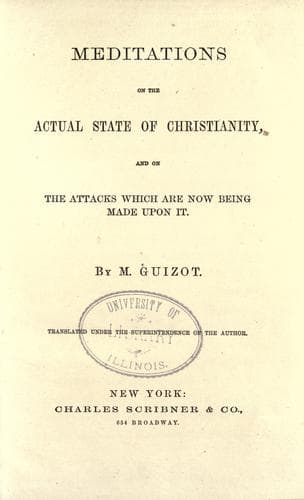
Meditations on the Actual State of Christianity, and on the Attacks Which Are Now Being Made Upon It.Guizot, François
Religion
Meditations on the Actual State of Christianity, and on the Attacks Which Are Now Being Made Upon It.
Guizot, François
Christianity; Philosophy and religion; Religious thought -- 19th century
It was one of the first effects of the Revolution in 1830, to
make visible to all the injury that the faults of their friends,
rather than the blows of their adversaries, had inflicted, under
the Restoration, upon the clergy, and through the clergy upon
religion. The acts of violence which, during the revolutionary
crisis from 1830 to 1832, were directed at the Churches--the
crosses thrown down, the insulting cries, and antichristian
manifestations; a little later, the riot before the church of St.
Germain l'Auxerrois, on the occasion of the service celebrated on
the anniversary of the death of the Duke de Berri--the
archiepiscopal palace ruined and pillaged--the church broken into
and closed--the menaces directed at the priests--what were all
these deplorable acts but the explosion of a popular reaction,
provoked by the share a part of the clergy had taken in favor of
a retrograde policy--of a return to the ancient régime and to
absolutism?
{85}
Violent men profited by this reaction to satisfy their impiety
and licentiousness, but they could never have excited the
movement or made it successful had they hoisted their own banner;
there must be some little truth before a populace will suffer
itself to be so misled; and the crowd who in February, 1831, so
furiously rose in insurrection before St. Germain l'Auxerrois,
would have paused in astonishment had it perceived that what it
was so brutally attacking and destroying was--not the ancient
régime, not absolutism--but religion and liberty.
To put an end to this confusion, full at once of deception and of
peril, but a single thing was required: to banish from the
Church, and from its relations with the State, worldly ambition
and influences, and to replace them by influences of a moral
description; instead of a political banner, they should have only
hoisted the banner of religious faith and liberty of conscience.
{86}
That was the great work, or, to use a better expression, the
great progress, which from 1830 to 1848 was aimed at and
accomplished.
Public-domain text, read in full here on John Shaqi.
Reviews
Reviews
No reviews yet
Be the first to share your thoughts on this work.
Elsewhere in the archive
Join the Discussion
Join the discussion
Sign in to leave a comment or review.
Sign InorCreate an account