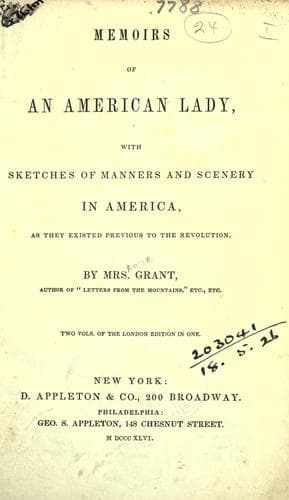
Memoirs of an American Lady: With Sketches of Manners and Scenery in America, as They Existed Previous to the RevolutionGrant, Anne MacVicar
History
Memoirs of an American Lady: With Sketches of Manners and Scenery in America, as They Existed Previous to the Revolution
Grant, Anne MacVicar
Indians of North America; New York (State) -- Social life and customs -- To 1775; Schuyler, Catalina, 1701-1778 or 1779
On the other side of the river, not very far from the Flats, lived a
person whom I shall not name, though his conduct was so peculiar and
characteristic of the times, that his anti-heroism is, on that sole
account, worth mentioning. This person lived in great security and
abundance, in a place like an earthly paradise, and scarcely knew what
it was to have an ungratified wish, having had considerable wealth left
to him; and from the simple and domestic habits of his life, had formed
no desires beyond it, unless, indeed, it were the desire of being
thought a brave man, which seemed his greatest ambition. He was strong,
robust, and an excellent marksman; talked loud, looked fierce, and
always expressed the utmost scorn and detestation of cowardice. The
colonel applied to him, that his name, and the names of such adherents
as he could bring, might be set down in the list of those who were to
bring their quota, against a given time, for the general defence: with
the request he complied. When the rendezvous came on, this talking
warrior had changed his mind, and absolutely refused to appear. The
general sent for him, and warmly expostulated on his breach of promise;
the bad example, and the disarrangement of plan which it occasioned. The
culprit spoke in a high tone, saying, very truly, that “the general was
possessed of no legal means of coercion; that every one went or staid as
they chose; and that his change of opinion, on that subject, rendered
him liable to no penalty whatever.” Tired of this sophistry, the enraged
general had recourse to club law, and seizing a cudgel, belaboured this
recreant knight most manfully, while several Indian sachems, and many of
his own countrymen and friends, coolly stood by—for the colonel’s noted
common was the scene of this assault. Our poor neighbour, (as he long
after became,) suffered this dreadful bastinado, unaided and unpitied;
and this example, and the consequent contempt under which he laboured,
(for he was ever after styled captain, and did not refuse the title,)
was said to have an excellent effect in preventing such retrograde
motions in subsequent campaigns.[5] The provincial troops, aided by the
faithful Mohawks, performed their duty with great spirit and
perseverance. They were, indeed, very superior to the ignorant,
obstinate, and mean-souled beings, who, in after times, brought the very
name of provincial troops into discredit; and were actuated by no single
motive but that of avoiding the legal penalty then affixed to
disobedience, and enjoying the pay and provisions allotted to them by
the province, or the mother country, I cannot exactly say which.
Afterwards, when the refuse of mankind were selected, like Falstaff’s
soldiers, and raised much in the same way, the New-York troops still
maintained their respectability. This superiority might, without
reproaching others, be in some measure accounted for from incidental
causes. The four New-England provinces were much earlier settled—assumed
Public-domain text, read in full here on John Shaqi.
Reviews
Reviews
No reviews yet
Be the first to share your thoughts on this work.
Elsewhere in the archive
Join the Discussion
Join the discussion
Sign in to leave a comment or review.
Sign InorCreate an account