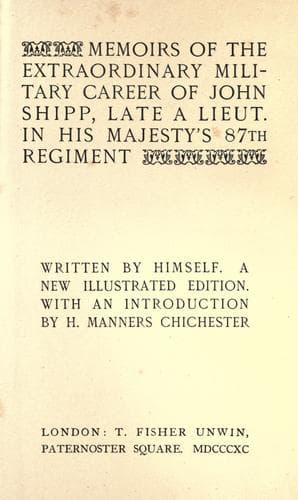
Memoirs of the Extraordinary Military Career of John Shipp: Late a Lieut. in His Majesty's 87th RegimentShipp, John
History
Memoirs of the Extraordinary Military Career of John Shipp: Late a Lieut. in His Majesty's 87th Regiment
Shipp, John
India -- History -- British occupation, 1765-1947 -- Biography; Shipp, John, 1784-1834
When the day dawned they were surrounded, and a general attack commenced
on all sides. Some were cut to pieces in their sleep, others in
endeavouring to escape. The carnage became terrific; his majesty's 8th,
24th, and 25th Dragoons, two regiments of native cavalry, and a corps of
horse-artillery, mowing them down with grape-shot in hundreds. About two
thousand were left dead on the field, and amongst the number several
poor tradespeople from Furrackabad, who had come to the spot to sell
their commodities. We pursued them many miles from the scene of action;
they, in their flight, burning the barracks and adjacent villages. The
same evening, or the following morning, the enemy reached the station of
Mainporee, a distance of seventy-two miles. At this station we had one
native corps only; but they were prepared to receive them. This little
band took possession of the house of the judge (Mr. Cunningham), and
defended themselves against Holkar's immense body of horse.
The battle of Furrackabad was on the 16th or 17th day of November,
1804; after which the enemy shifted their course towards the fort of
Deig, the property of the Bhurtpore rajah. In the neighbourhood were his
infantry, about twenty-five thousand men, with upwards of a hundred
pieces of cannon. Holkar little dreamt that, on the 13th of the same
month, his infantry had met with a similar defeat to that which his
cavalry had experienced on the 16th. Major-General Frazer, with a small
force, had completely routed and defeated them, taking all their guns
and stores. This action was at several intervals extremely doubtful, our
force being so inadequate to that of the enemy. We had no European
regiment there, except the Company's European regiment, and the 76th
Foot, both corps not more than six or seven hundred men. The enemy
sought protection under the walls of the fort; and, although our ally,
the governor of the fort of Deig, fired on our army, General Frazer,
seeing the danger of a defeat, charged at the head of the 76th,
supported by the European regiment and native troops, and succeeded in
driving them from their guns, and from the protection of the fort; but,
in the heat of the action, the gallant general received a ball in the
foot, and was obliged to retire from the field. He died a short time
afterwards. Colonel the Honourable W. Monson, on whom the command
devolved, completed his work, and a decisive victory was the result.
Holkar, being informed of the disaster of his infantry, then shifted his
course towards Bhurtpore, demanding immense sums of money from the
rajah, under threats of laying waste his country, which at that time
might be called the garden of India. His encampment was close under the
walls of the fort, leaving a body of about two thousand men to harass
and annoy us.
Public-domain text, read in full here on John Shaqi.
Reviews
Reviews
No reviews yet
Be the first to share your thoughts on this work.
Elsewhere in the archive
Join the Discussion
Join the discussion
Sign in to leave a comment or review.
Sign InorCreate an account