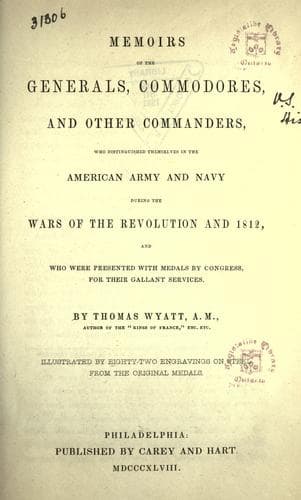
Memoirs of the Generals, Commodores and other Commanders, who distinguished themselves in the American army and navy during the wars of the Revolution and 1812, and who were presented with medals by Congress for their gallant servicesWyatt, Thomas
History
Memoirs of the Generals, Commodores and other Commanders, who distinguished themselves in the American army and navy during the wars of the Revolution and 1812, and who were presented with medals by Congress for their gallant services
Wyatt, Thomas
United States -- History -- Revolution, 1775-1783 -- Biography; United States -- History -- Revolution, 1775-1783 -- Medals; United States -- History -- War of 1812 -- Biography; United States -- History -- War of 1812 -- Medals
another, the stars of our revolutionary firmament are sinking below the
horizon. They rise in another hemisphere, as they set to us; and the
youth of other times will gaze upon their lustre, as he learns their
names and marks them clustering into constellations, which will recall
to his mind some interesting event of our period of struggle.” An able
historiographer thus speaks of the lamented Howard: “In private life he
was distinguished for the amenity of his manners, his hospitality, and
his extensive and useful knowledge. He possessed a memory uncommonly
minute, and a love of information that never sank under the labor of
acquisition. These faculties rendered him, perhaps, the most accurate
repository of the history of his own time, in this or any other
country. His habits of life were contemplative, cautious, scrupulously
just, and regulated by the strictest method. Few men have enjoyed a
more enviable lot;--his youth distinguished in the field, his age in
the council, and every period solaced by the attachment of friends.
Affluent in fortune, as rich in public regard, and blessed in his
domestic and personal associations, he has glided away from the small
band of his compatriots, as full of honors as of years. The example
of such a citizen is a legacy to his country, of more worth than the
precepts of an age.”
MEDAL.
OCCASION.--Victory at the Cowpens, N. Carolina.
DEVICE.--An officer mounted, with uplifted sword, pursuing an officer
on foot, bearing a stand of colors: Victory descending in front over
the former, holding a wreath in her right hand over his head: a
palm-branch in her left hand.
LEGEND.--John Eager Howard, legionis peditum præfecto comitia Americana.
REVERSE INSCRIPTION--(_within a laurel wreath_.)--Quod in nutantem
hostium aciem subito irruens, præclarum bellicæ virtutis specimen dedit
in pugna, ad Cowpens, 17th January, 1781.
COL. WILLIAM A. WASHINGTON.
William Augustine Washington was the eldest son of Baily Washington, of
Stafford county, Virginia. The subject of these memoirs had commenced
his studies for the church, when the war sound of the revolution rung
in his ears; he was one of those who exerted such an exalted influence
throughout the whole campaign, that his biographers distinguish him as
the “modern Marcellus.”
Colonel Washington was a scholar of rare attainments, especially in the
Greek language, in which, in his day, he was unequalled. At the request
of his relative, General George Washington, he was appointed to the
command of a company of infantry, in the third regiment of the Virginia
line.
He was distinguished for his manly fortitude in sustaining the greatest
difficulties and dangers.
Reviews
Reviews
No reviews yet
Be the first to share your thoughts on this work.
Join the Discussion
Join the discussion
Sign in to leave a comment or review.
Sign InorCreate an account