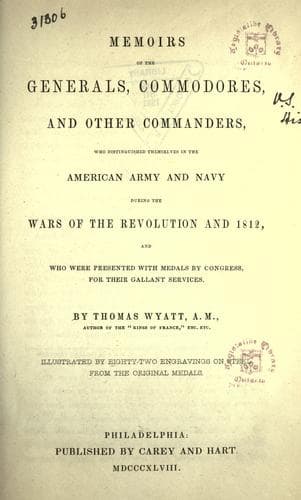
Memoirs of the Generals, Commodores and other Commanders, who distinguished themselves in the American army and navy during the wars of the Revolution and 1812, and who were presented with medals by Congress for their gallant servicesWyatt, Thomas
History
Memoirs of the Generals, Commodores and other Commanders, who distinguished themselves in the American army and navy during the wars of the Revolution and 1812, and who were presented with medals by Congress for their gallant services
Wyatt, Thomas
United States -- History -- Revolution, 1775-1783 -- Biography; United States -- History -- Revolution, 1775-1783 -- Medals; United States -- History -- War of 1812 -- Biography; United States -- History -- War of 1812 -- Medals
Such is the unadorned narrative of this brave and gallant soldier.
At the battle of Hobkirk’s Hill, he also ably distinguished himself.
At Eutaw he had the command of the second Maryland regiment, who
distinguished themselves at the bayonet’s point, and (according to Lee)
in encountering the obstinate resistance of the Buffs, many of the
Marylanders and of the Buffs were mutually transfixed with each other’s
bayonets. Colonel Howard, in a letter, says, “nearly one-half of my
men were killed or wounded, and I had seven officers out of twelve
disabled; four killed, and three severely wounded.” Towards the end
of the battle, Colonel Howard received a ball in the left shoulder,
which, passing entirely through, came out under the shoulder-blade, and
disabled him. In a letter from General Greene to General Smallwood,
written a few days after the battle, he says, “nothing could exceed
the gallantry of the Maryland line, the uncommon bravery of Colonels
Howard, Williams, and the other officers, and the free use of the
bayonet, by this and some other corps, gave us the victory.”
As soon as he was able to be removed, Colonel Howard was taken home,
followed by the affectionate commendations of his brother officers.
General Greene, in writing to a friend, after his departure, says,
“Colonel Howard is as good an officer as the world afforded, and
deserves a statue of gold, no less than the Roman or Grecian heroes.”
At the conclusion of the war, Colonel Howard retired to his estates
in Baltimore county, and soon after married Margaret, the daughter of
Benjamin Chew, of Philadelphia. He was shortly after chosen governor
of Maryland, which office he filled for three years. In 1795, General
Washington invited him to a seat in his cabinet, but this was declined.
In 1796, he was transferred from the legislature of his own state to
the senate of the United States, where he remained seven years; he then
returned again to his agricultural pursuits, where he remained till
the trumpet of war broke in upon his retirement in 1814. The capture
of Washington by the enemy, and the meditated attack upon Baltimore,
demanded a preparation for resistance, and a troop of aged men was
organized to render such services as their strength would allow, and
Colonel Howard was, by unanimous consent, placed at its head. Colonel
Howard now began to feel the effects of his early wound, which at
every slight exposure brought on severe pain, which made inroads in
his constitution not easily repaired. In 1821 he had the misfortune
to lose his eldest daughter, and in 1822 his eldest son, and in 1824,
the loss of his devoted wife gave him a shock from which he never
recovered; from that time his health began fast to decline, and in
October, 1827, he resigned his life with characteristic fortitude and
pious resignation. An obituary notice written by a celebrated dignitary
of the Catholic church, demands a place in these pages. “One after
Public-domain text, read in full here on John Shaqi.
Reviews
Reviews
No reviews yet
Be the first to share your thoughts on this work.
Join the Discussion
Join the discussion
Sign in to leave a comment or review.
Sign InorCreate an account