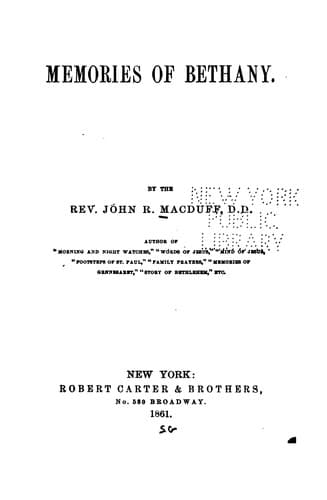
Jesus Christ -- Biography -- Sermons; Lazarus, of Bethany, Saint
Such is a brief sketch of this beautiful domestic scene, and its main
practical lessons,--a green spot on which the eye will ever love to
repose, among the "Memories of Bethany." It is unnecessary to advert to
the controverted question, as to whether the description of the
anointing, which took place in the house of Simon the leper (as recorded
in Matt. xxvi. 6-14, and Mark xiv. 3), and where the alabaster box is
spoken of, be identical with this passage, or whether they refer to two
distinct occasions. The question is of no great importance in
itself--the former view (that they are descriptions of one and the same
event) seems the more probable. It surely gives a deep intensity to the
interest of the narrative to imagine the Leper and the raised dead man,
seated at the same table together with their common Deliverer,
glorifying their Saviour-God, with bodies and spirits they felt now to
be doubly _His_! Simon, it is evident, must have been cured of his
disease, else, by the Jewish law, he dared not have been associating
with his friends at a common meal. How was he cured? How else may we
suppose was that inveterate malady subdued but by the omnipotent word of
_Him_, who had only to say,--"I will, be thou made whole!" May we not
regard him as a standing miracle of Jesus' power over the diseased body,
as Lazarus was the living trophy of His power over death and the grave.
The one could testify,--"This poor man cried, and the Lord saved him,
and delivered him out of all his troubles." The other,--"Unless the Lord
had been my help, my soul must now have dwelt in silence!"
Public-domain text, read in full here on John Shaqi.
Reviews
Reviews
No reviews yet
Be the first to share your thoughts on this work.
Join the Discussion
Join the discussion
Sign in to leave a comment or review.
Sign InorCreate an account