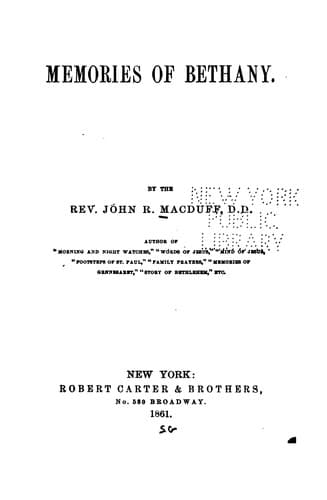
Jesus Christ -- Biography -- Sermons; Lazarus, of Bethany, Saint
These were indeed eventful hours on which they had now entered. The stir
through Palestine of the thousands congregating in the earthly Jerusalem
to the great Paschal Feast, was but a feeble type of the profound
interest with which myriad angel-worshippers in the Jerusalem above were
gathering to witness the offering of the True Paschal Sacrifice, "the
Lamb slain from the foundation of the world."
On the morning after the supper at Bethany (probably that of our
Sabbath), the Saviour rose from His couch of needed rest to approach
Jerusalem. The reserve hitherto maintained as to His kingly power is now
to be set aside. "The hour is come in which the Son of man is to be
glorified." BETHANY is one of the few places associated with
recollections of the Redeemer's royalty. The "despised and rejected" is,
for once, the honoured and exalted. It is a glimpse of the crown before
He ascends the cross; a foreshadowing of that blessed period when He
shall be hailed by the loud acclaim of earth's nations--the Gentile
hosannah mingling with the Hebrew hallelujah in welcoming Him to the
throne of universal empire.
Multitudes of the assembled pilgrims in the city, who had heard of His
arrival, crowded out to Bethany to witness the mysterious Being, whose
deeds of mercy and miracle had now become the universal theme of
converse. His mightiest prodigy of power in the resurrection of Lazarus
had invested His name and person with surpassing interest. We need not
wonder, therefore, that "the town of Mary and her sister Martha" should
attract many worshippers from Jerusalem, to behold with their own eyes
at once the restored villager and his Divine Deliverer! In fulfilment of
Zechariah's prophecy, the meek and lowly Nazarene, seated on no
caparisoned war-horse, but on an unbroken colt, and surrounded with the
multitude, sets forth on His journey.[26] "The village and the desert
were then all alive (as they still are once every year at the Greek
Easter) with the crowd of Paschal pilgrims moving to and fro between
Bethany and Jerusalem. ... Three pathways lead, and probably always led,
from Bethany; ... one a long circuit over the northern shoulder of Mount
Olivet, down the valley which parts it from Scopus; another, a steep
footpath over the summit; the third, the natural continuation of the
road by which mounted travellers always approach the city from Jericho,
over the southern shoulder between the summit which contains the Tombs
of the Prophets, and that called the 'Mount of Offence.' There can be no
doubt that this last is the road of the entry of Christ, not only
because, as just stated, it is, and must always have been, the usual
approach for horsemen and for large caravans such as then were
concerned, but also because this is the only one of the three approaches
which meets the requirements of the narrative which follows. ... This is
the only one approach which is really grand. It is the approach by which
Public-domain text, read in full here on John Shaqi.
Reviews
Reviews
No reviews yet
Be the first to share your thoughts on this work.
Elsewhere in the archive
Join the Discussion
Join the discussion
Sign in to leave a comment or review.
Sign InorCreate an account