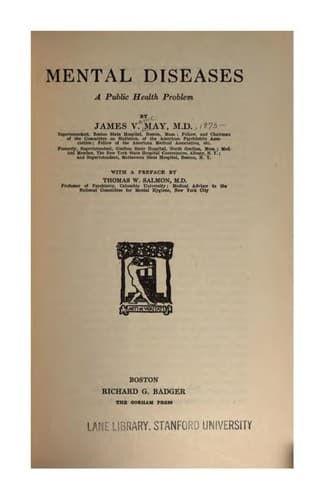
Mental diseases: a public health problemMay, James Vance
Science
Mental diseases: a public health problem
May, James Vance
Mental health services; Psychology, Pathological
When the care and treatment of mental diseases was first undertaken in
our state institutions it was soon found necessary to take advantage
in every way of such material assistance as could be offered by the
more intelligent class of ablebodied patients in carrying on the
routine work of the hospital. There were never employees enough to
dispense with their services. In this way it came about that they
were employed in the farms and gardens, assisted with the kitchen and
housework, shared the tasks of the nurses and attendants in the wards
and were busily engaged in almost every department of the hospital
activities. It became apparent that occupation, undertaken originally
for purely economical purposes, constituted one of the most important
therapeutic agents at the disposal of the institution. The next step
was the development of industries. Patients were taught by instructors
to make clothing, underwear, stockings, shoes, brooms, mats, brushes,
mattresses, furniture and many other useful products needed by the
hospital. The end products were in every instance utilitarian. These
accomplishments led to a still further development—purely occupational
in character. Women were encouraged to take up such activities as rug
making of all varieties, basketry, weaving, crocheting, embroidery,
and needlework of every description. Men usually make towelling on
looms, weave rugs, renovate mattresses, do repairing of all sorts and
manufacture small articles which interest the masculine mind. Brass
work, clay modelling and making jewelry of various kinds have been
extensively employed.
All of these forms of employment mean, of course, that the patient
must leave the ward and go to some place designed for the purpose. The
others, however, have not been overlooked and occupational therapists,
who devote their entire time to stimulating the interest of the
patients who cannot leave the wards, on account of their mental or
physical condition, in some absorbing and diverting occupation, are
an important part of the personnel of every institution. No other
form of treatment employed in hospitals for mental diseases has been
so productive of results. It is interesting to note that the medical
officers of all of the forces engaged in the recent war found that
occupational therapy was of great value in cases of shell shock and war
neuroses.
Public-domain text, read in full here on John Shaqi.
Reviews
Reviews
No reviews yet
Be the first to share your thoughts on this work.
Join the Discussion
Join the discussion
Sign in to leave a comment or review.
Sign InorCreate an account