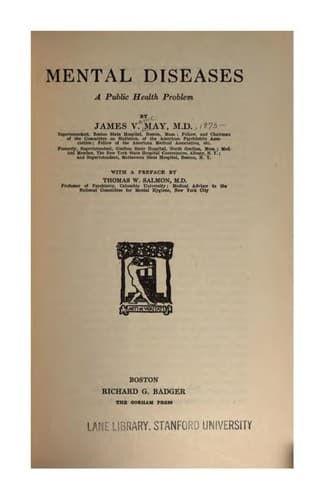
Mental diseases: a public health problemMay, James Vance
Science
Mental diseases: a public health problem
May, James Vance
Mental health services; Psychology, Pathological
The building has a capacity of one hundred and ten beds. The
institution may be said to differ from other psychopathic hospitals
in being an establishment essentially of the temporary care type,
not designed primarily either for the reception or for the care and
custody of obviously committable cases, but rather for the observation
and treatment of incipient mental disorders as well as psychopathic
conditions not properly coming within the scope of the state hospitals.
It has been as a rule the policy of the court to commit directly to
other institutions for the insane all cases showing clearly the
necessity of an extended hospital residence. The fact that only forty
per cent of the temporary care cases have been committed shows that a
preliminary period of observation before these cases are definitely
disposed of is unquestionably warranted. The legal status of cases
admitted may be described as follows:—1. Temporary care (not to exceed
ten days); 2. Boston Police cases (Persons suffering from delirium,
mania, mental confusion, delusions or hallucinations, or who come
under the care or protection of the police); 3. Observation cases (for
a period of thirty-five days, pending commitment); 4. Cases pending
examination and hearing; 5. Emergency commitments (not more than five
days); 6. Voluntary admissions; 7. Cases held under complaint or
indictment.
An analysis of the work done by the Psychopathic Department from 1912
to 1920 shows a total of 14,922 admissions to the wards,—an average of
1,865 per year. Of these, 59.77 per cent were temporary care (10 day)
cases, 18.56 per cent "Boston Police" cases, 1.38 per cent observation
cases (thirty-five days), .50 per cent emergency cases, .61 per cent
committed "pending examination and hearing," 1.02 per cent under
complaint or indictment and 16.96 per cent were voluntary cases. The
entire temporary care group, including all of the above classes except
the voluntary and criminal cases, constituted 81.34 per cent of the
admissions. It is interesting to note that the principal psychoses
represented by the cases coming into the hands of the Boston Police
are dementia praecox, alcoholic psychoses and mental deficiency. The
number of emergency cases is very small, as is the number committed by
courts for observation. The number of voluntary admissions, an average
of 316 per year, constituting 16.96 per cent of the total, is very
significant as showing the response to be expected from the public to
an opportunity for hospital treatment without the formality of any
legal procedure. Of the 14,922 cases admitted between 1912 and 1920,
38.45 per cent were subsequently committed as insane and 3,797, or
25.44 per cent, were returned to the community as not requiring further
hospital care or treatment.
Public-domain text, read in full here on John Shaqi.
Reviews
Reviews
No reviews yet
Be the first to share your thoughts on this work.
Elsewhere in the archive
Join the Discussion
Join the discussion
Sign in to leave a comment or review.
Sign InorCreate an account