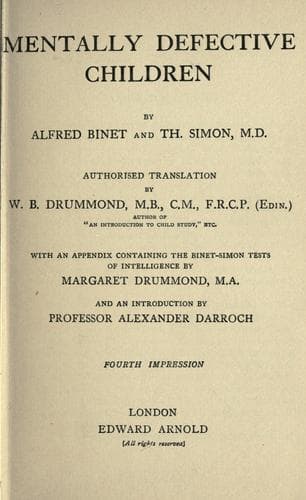
Children with mental disabilities -- Education; Children with mental disabilities -- Psychological testing
We have just pointed out the importance of reserving the schools for
defectives for improvable cases. But it is necessary to correct this
word "improvable," because all defectives can be improved more or
less. Their asserted _arrest_ of development is not complete, and the
expression is equivocal. It would be better to replace the word
"improvable" by the following more precise phrase: "Capable of being
taught to gain, in part, their own living." Which of them are in this
position? Unfortunately, we do not know. All such questions should
have been solved long ago, since thousands of defectives have passed
into the hospices. It would have been enough to have followed them up,
to have found out what became of them, and to have drawn conclusions.
But this has never been done methodically, and for the present we are
reduced to conjecture. The nearest estimate we can form is that the
social value of any individual case, not epileptic, is in inverse
proportion to the degree of deficiency; the imbecile would seem to be
more improvable than the idiot, and the feeble-minded than the
imbecile. But this is simply hypothesis, and we accept it quite
provisionally, until exact investigations have been made which will
permit us to replace conjecture by demonstrated truth. Consequently we
shall open wide the doors of the school to the feeble-minded and close
them to the idiots, while as to the imbeciles, we shall have to find
out whether the proper place for them is the school or the hospice. It
will be necessary to find out in what measure, and at the price of
what effort, an imbecile can be instructed to the point, say of being
able to read. There are two other indications which may help us. Cases
of _acquired_ mental deficiency--that is to say, cases who have
become defective as the result of something which affected them after
birth--are usually less improvable than _congenital_ cases, or cases
where the deficiency is due to some cause acting before birth. And,
secondly, cases affected by epilepsy, with fits or frequent attacks of
vertigo, usually undergo a progressive mental deterioration.
What distinctions can we draw between the different degrees of mental
deficiency? Such a question, we think, might be asked with regard to
the ill-balanced as well as the defective. With respect to the former,
we have no criterion at present to offer. It will be enough to pick
out and send to the hospices _the most ill-balanced_, those whose
presence among normal children would be a danger owing to the
perversion of their instincts or the brutality of their impulses.
Public-domain text, read in full here on John Shaqi.
Reviews
Reviews
No reviews yet
Be the first to share your thoughts on this work.
Join the Discussion
Join the discussion
Sign in to leave a comment or review.
Sign InorCreate an account