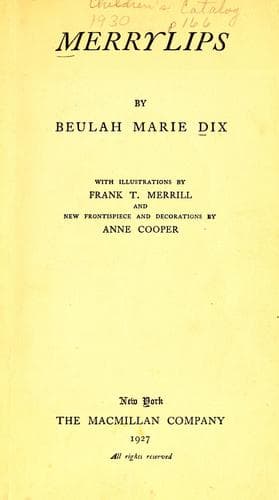
Girls -- Juvenile fiction; Great Britain -- History -- Civil War, 1642-1649 -- Juvenile fiction
"Lady Sybil--for whom thou art named? But then--Why, Tibbott, is it
true thou art not Tibbott--that thou art a little maid?"
"Ay!" she answered with her face hidden.
Presently she felt her two hands found and taken into Rupert's hands.
"Prithee, look up!" he said. "And be not sorry. My word, I might ha'
guessed it--only no one of all the men mistrusted! 'Twas because
thou wast a maid, belike, thou hadst so tender a heart, even for
the pestilent rebels. And I mocked at thee for it. I am right sorry,
mistress."
She looked up at Rupert then. She felt that at last they knew each
other and would be friends. She was so glad that she smiled at him, and
he too laughed as he knelt before her.
"How thou didst trick us all!" he cried. "Why, Tibbott--mistress, I
mean--"
"My brothers call me Merrylips," she said.
Rupert cocked his head, as if he thought the name odd, but he repeated,
"Merrylips," and they laughed together.
"I never knew of such a maid," Rupert kept repeating. "How couldst thou
walk as thou hast done, and fare so poorly, and not fret, thou that
hast been reared a gentlewoman?"
Then he hesitated and seemed to remember something.
"Merrylips," he asked, "did I dream it, or didst thou say indeed that
thou didst dwell with thy godmother at a place called Larkland?"
Merrylips nodded. Rupert passed his hand across his forehead.
"There was a house called Larkland," he said slowly, "when we came
first into England, Claus and I, and a sickness was on me. And there
was a kind little maid that led us home, and said we should be friends."
He paused, and sat gazing at Merrylips.
"Yes," she answered, "and next morning I sat in the cherry tree and saw
thee stealing away from Larkland."
"Then it was thou indeed!" cried Rupert. "And I never knew thee,
Tibbott,--Merrylips, I mean,--though I had thought upon thee often, for
thou wast so kind, when every one was harsh unto us."
But now that Merrylips remembered the old days at Larkland and her
godmother's suspicions of Rupert, she grew sober again.
"Wilt thou not tell me, Rupert," she said, "why thou didst steal away
from Larkland, so like a thief, when we all would have used thee
kindly?"
For a moment Rupert was silent. Then he drew from his pocket the silver
ring that was the counterpart of the one that hung at Merrylips' neck.
"If I tell thee a part, I will tell thee all," he said, "and I am fain
to tell thee, if thou wilt listen."
"Tell me everything," bade Merrylips.
So the two children settled themselves, side by side, under the bare
willows, and Rupert told the story of his silver ring.
CHAPTER XXVI
HE THAT WAS LOST
"First of all," Rupert began, "my name is not Rupert Hinkel, no more
than thine is Tibbott. I am no kinsman to Claus Hinkel, nor to any
peasant folk. I am a gentleman's son, and come of as good blood, they
say, as any in all England."
Public-domain text, read in full here on John Shaqi.
Reviews
Reviews
No reviews yet
Be the first to share your thoughts on this work.
Elsewhere in the archive
Join the Discussion
Join the discussion
Sign in to leave a comment or review.
Sign InorCreate an account