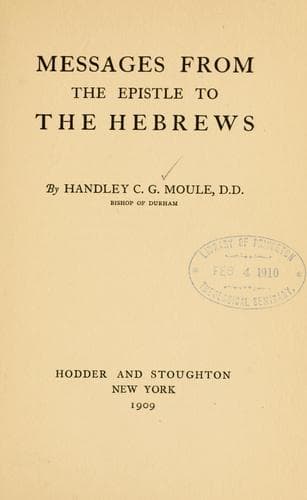
Messages from the Epistle to the HebrewsMoule, H. C. G. (Handley Carr Glyn)
Religion
Messages from the Epistle to the Hebrews
Moule, H. C. G. (Handley Carr Glyn)
Bible. Hebrews -- Commentaries
The last chapter of the Epistle has a character quite of its own. Unlike
many of those often arbitrary divisions of the New Testament books which
we know as chapters, it is a naturally separate section. The long and
sustained arguments are over. The Writer's thoughts, gravitating to a
close, and occupied naturally as they do so with the personal conditions
of his Hebrew brethren, attach themselves now to one now to another side
of their duties, their difficulties, their more particular and detailed
needs, practical and spiritual. As he touches upon these, sentence by
sentence, we often see at a glance the probable occasion of the words,
but often again we are left in the dark about it. Who shall say
precisely why he insists (ver. 2) upon the exercise of hospitality? or
who were "the prisoners" (ver. 3) whom he bids them remember? Who shall
tell what in this particular community was the occasion for a solemn
emphasis (ver. 4) upon the holiness of marriage, or why again, just for
them, it was well to speak in warning (ver. 5) about the love of money
and the temptation to discontent? Nor can we be certain who were those
departed "leaders," "guides," of ver. 7, whose "faith" the disciples
were to "imitate," whose blessed "exit from their walk of life" they
were to "contemplate."
All we can say of these opening topics of the chapter is that, whatever
the occasions were, the words occasioned are for us inestimably
precious. Dear to the heart of the believing Church for ages have been
these precepts to love the brethren ([Greek: philadelphia]), to love the
stranger ([Greek: philoxenia]), to remember Abraham at Mamre and Gideon
at Ophrah with their angel-guests, and to see a possible angel-visitor
in every needing stranger at the door. The call (ver. 2) to remember the
captive, and the sufferer of every sort, comes with solemn power from
this paragraph, as it presses home the law of sympathetic fellowship,
and in one passing phrase ("_as being in the body_") reminds us that,
for the Christian, all sufferings, all burthens of pain and care, cease
for ever when once he is "out of the body." Sacred is the witness borne
here to the pure dignity of wedlock (ver. 4): "Be[S] marriage
honourable in all things, and the bed unspotted; for fornicators and
adulterers"--not only adulterers, but those also who sin that other sin
which the world so easily and so blindly condones--"God will judge." And
when the Christian is warned (ver. 5) against the greed of gain, the
quoted words of the Old Testament make, by the use they are put to, a
possession for ever valuable to the believing reader of the Scriptures.
For not only are they in themselves wonderful in their emphasis: "I will
never give thee up; I will never, never desert thee." They are
inestimable as an example of the sort of use which this New Testament
prophet could make of the spiritual riches of the Old Testament. For
here he sees a Divine watchword for the new life, not only in the
Public-domain text, read in full here on John Shaqi.
Reviews
Reviews
No reviews yet
Be the first to share your thoughts on this work.
Join the Discussion
Join the discussion
Sign in to leave a comment or review.
Sign InorCreate an account