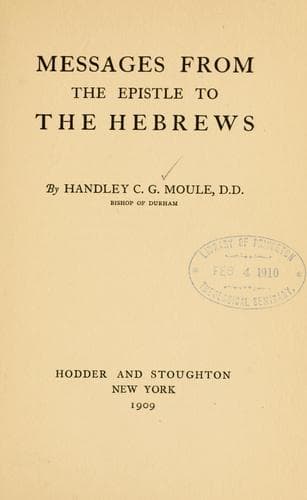
Messages from the Epistle to the HebrewsMoule, H. C. G. (Handley Carr Glyn)
Religion
Messages from the Epistle to the Hebrews
Moule, H. C. G. (Handley Carr Glyn)
Bible. Hebrews -- Commentaries
glorious outburst of faith (ver. 6) in Psalm cxviii., the _Hallel_ of
the Passover. In the words spoken to Joshua, and to all appearance
spoken _to him personally and alone_ (ver. 5: see Josh. i. 5), we are
led equally to see a message from the heart of God straight to every
Christian soul. Seldom, if ever, are we more powerfully and tenderly
encouraged than we are here to use with confidence that old-fashioned
and now often disparaged sort of Bible study, the collection of eternal
and universal principles of spiritual life out of an "isolated text."
[S] The sentence demands an understood _imperative_ verb, without which
the "_for_" which (in the true reading) introduces the second clause is
out of place.
Then comes the passage where the departed "guides" are commemorated.
Whoever they were, were they a Stephen and a James, or saints utterly
unknown to us, that passage is precious in its principles, true for all
time, of remembrance and appeal. It consecrates the fidelity of the
Christian memory. It assures us that to cherish the names, the words,
the conduct, the holy lives, the blessed deaths, of our teachers of days
long done is no mere indulgence of unfruitful sentiment. It is natural
to the Gospel, which, just because it is the message of an unspeakably
happy future, also sanctifies the past which is the living antecedent to
it. Just because we look with the love of hope towards "our gathering
together unto Him," we are to turn with the love of memory towards all
the gifts of God given to us through the holy ones with whom we look to
be "gathered together." "The exit of their walk of life" (ver. 7) is to
be our study, our meditation. We are to "look it up and down" ([Greek:
anatheorountes]) as we would some great monument of victory, and from
that contemplation we are to go back into life, to "imitate their
faith," to do just what they did, treating (xi. 1) the unseen as
visible, the hoped-for as present and within our embrace. Thank God for
this authorization and hallowing of our recollections. Precious indeed
is its assurance that the sweetness of them (for all its ineffable
element of sadness, as eyes and ears are hungry for the faces and the
voices gone, for the look and tone of the preacher, the teacher, through
whom we first knew the Lord, or knew Him better) is no half-forbidden
luxury of the soul but a means of victorious grace.
Public-domain text, read in full here on John Shaqi.
Reviews
Reviews
No reviews yet
Be the first to share your thoughts on this work.
Join the Discussion
Join the discussion
Sign in to leave a comment or review.
Sign InorCreate an account