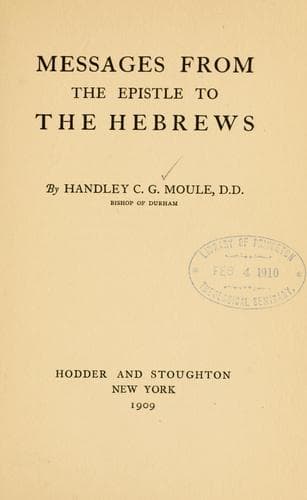
Messages from the Epistle to the HebrewsMoule, H. C. G. (Handley Carr Glyn)
Religion
Messages from the Epistle to the Hebrews
Moule, H. C. G. (Handley Carr Glyn)
Bible. Hebrews -- Commentaries
Here follows in close sequence a passage of pregnant significance. It
begins with ver. 10, and the connexion is not finally broken till ver.
16. The Writer, prompted perhaps by the allusion to a ceremonial law of
"meats," turns abruptly to the still existing ritual of the Law,
familiar to his Hebrew readers as to himself. From it he leads their
thoughts once more to the profound import and ultimate efficacy of the
supreme atoning Sacrifice, in all its shame and all its glory, and to
the call which that great fact conveys to the believer to break for
ever, at whatever cost, from the old order, _considered as a rival to
the Cross_. Such is the true bearing of this often debated passage, if I
am not greatly mistaken. The "altar" which "we have" (ver. 10) is not,
if I read the argumentative context rightly, either the atoning Cross,
at least as to any direct reference of the word, or the Table of the
Christian Eucharist. As to this latter conjecture indeed the reference
is totally unsupported by any really primeval parallel.[T] And _in this
Epistle_ it is scarcely conceivable that, if that were the meaning, if
we were to be abruptly informed here that we Christians have in the Holy
Table a sacrificial altar, no allusion, however slight, should intimate
that the Christian minister is not a "leader" only but a sacrificing
priest. The whole Epistle may be said to circle round the great topic of
Priesthood. From various points of view, and with purposes as practical
as possible in regard of faith, hope, and life, that topic has been
handled. But is it too much to say that, for the Writer, the one
Christian priesthood which is analogous to the Levitical priesthood, as
a sacrificial and mediatorial function on behalf of the Church, is the
High Priesthood of the Son of God? The Christian Ministry indeed hardly,
if at all, comes into view throughout the argument. We find it at length
in this chapter, the chapter which tells the readers that they "have an
altar." Twice over the pastors of the Church are mentioned here (verses
7, 17); but how? As "leaders," "guides," [Greek: hegoumenoi]: as those
who "speak the word of God," as those whose vigilance over the souls of
the flock claims a loving and grateful loyalty. That is to say, the
Christian Ministry is above all things a pastorate. To a sacerdotal
aspect of its special functions no reference appears. And that is
noteworthy just because of the profound sacerdotalism of the whole
context of the Epistle.
[T] Lightfoot (on Ign. _ad Eph. v., et alibi_) has clearly shewn that
Ignatius' use of [Greek: thysiasterion] is altogether mystical. He means
not the Holy Table but (among other references) the Church of Christ as
the sphere or place of spiritual sacrifice.
Public-domain text, read in full here on John Shaqi.
Reviews
Reviews
No reviews yet
Be the first to share your thoughts on this work.
Join the Discussion
Join the discussion
Sign in to leave a comment or review.
Sign InorCreate an account