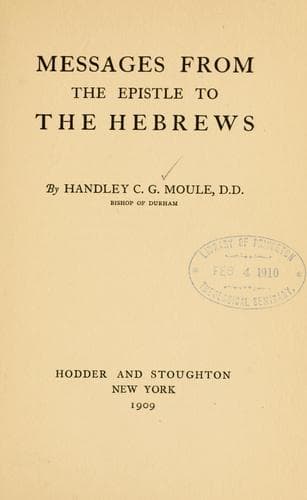
Messages from the Epistle to the HebrewsMoule, H. C. G. (Handley Carr Glyn)
Religion
Messages from the Epistle to the Hebrews
Moule, H. C. G. (Handley Carr Glyn)
Bible. Hebrews -- Commentaries
The connexion of ver. 15 with the antecedent context is suggestive. We
have been led to a contemplation of the Lord Jesus in His character as
Antitype and Fulfilment of the holocaust of the Levitical atonement.
Even as the chief animal victim of the old covenant, the symbolical
bearer of the sins of Israel, was carried "outside the camp" to be
consumed, so our Victim was led "outside the gate" of the city to His
death, that there, by His blood-shedding, by His absolute and perfect
self-immolation in our stead, He might "hallow His people," bringing
them forgiven and welcomed back to God. The point of the dread ritual of
Calvary here specially emphasized is just this, that He "suffered
outside the gate." The old Israel, guiltily unknowing, fulfilled the
type in the Antitype by refusing Him place even to die within the sacred
city. He, in His love for the new Israel, that He might in every
particular be and do what was foreshadowed for Him, refused not to
submit to that supreme rejection.
From this the apostolic Writer draws two messages for his readers. First
(ver. 13) they are to follow the Lord outside, willing to be rejected
like Him and because of Him. They are to be patient, for His sake, when
they are "put out of the synagogues" and reproached as traitors to
Moses. They are by faith to conquer the cry of their human hearts as
they crave perpetuity for the beloved past; they are to remember (ver.
14), as they issue from the old covenant's gate into what seems the
wild, that "Jerusalem that now is" was built for time only, and that
they belong to the city of eternity, where their High Priest sits on His
throne to bless them now and welcome them hereafter. Then, secondly and
therefore (ver. 15), they are to use Him now and for ever as their one
sacerdotal Mediator. By Him, not by the Aaronic ministry, they are to
bring their sacrifices to God. They are to accept exclusion and to turn
it into inclusion, into a shutting-up of all their hopes and all their
worship into their glorious Christ. And what now is their altar-ritual
to be? It is to be twofold; the offering of praise, "the fruit of lips
that confess" the glory of "His Name," and then the sacrifice of self
and its possessions for others for His sake (ver. 16); "doing good, and
communicating" blessings; for these are "altar-sacrifices ([Greek:
thysiai]) with which God is well pleased."
Such, if we are right, is the connexion. The Lord, rejected, that He
might die for us after a manner faithful to the prophetic type, is to be
the Hebrew disciple's example of patience when he too is rejected. Such
rejection is only to unite him the more closely to the Christ as his way
to God, his Mediator for all the praise and all the unselfish service
which is to fill his dedicated life.
Public-domain text, read in full here on John Shaqi.
Reviews
Reviews
No reviews yet
Be the first to share your thoughts on this work.
Join the Discussion
Join the discussion
Sign in to leave a comment or review.
Sign InorCreate an account