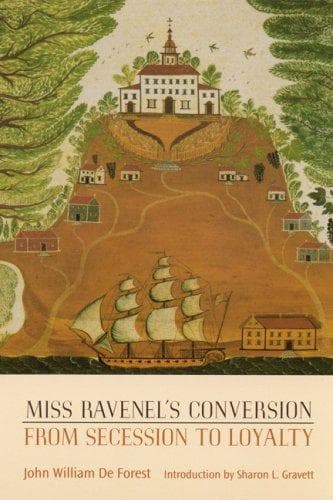
Miss Ravenel's conversion from secession to loyaltyDe Forest, John William
History
Miss Ravenel's conversion from secession to loyalty
De Forest, John William
Historical fiction; United States -- History -- Civil War, 1861-1865 -- Fiction; War stories; Women -- United States -- Fiction
"Nonsense! Beg your pardon. Did you never read of Austerlitz and Jena
and Waterloo? Our men did pretty well for militia. I didn't see the
panic, to be sure;--I was picked up before that happened. But I have
talked with some of our officers who did see it, and they told me that
the papers exaggerated it absurdly. Newspaper correspondents ought not
to be allowed in the army. They exaggerate every thing. If we had gained
a victory, they would have made it out something greater than Waterloo.
You must consider how easily inexperience is deceived. Just get the
story of an upset from an old stage-driver, and then from a lady
passenger; the first will tell it as quite an ordinary affair, and the
second will make it out a tragedy. Now when some old grannies of
congressmen and some young ladies of newspaper reporters, none of whom
had ever seen either a victory or a defeat before, got entangled among
half a dozen disordered regiments they naturally concluded that nothing
like it had happened in history. I tell you that it wasn't unparalleled,
and that it ought not to have been considered surprising. Whichever of
those two green armies got repulsed was pretty sure to be routed. That
was a very pretty manoeuvre, though, that coming up of Johnston on our
right. Patterson ought to be court-martialed for his stupidity."
"Stupidity! He is a traitor," exclaimed Colburne.
"Oh! oh!" expostulated the Colonel with a cough. "If we are to try all
our dull old gentlemen as traitors, we shall have our hands full. That's
something like hanging homely old women for witches.--By the way, how
are the Allstons? I mean the--the Ravenels. Well, are they? Young lady
as blooming and blushing as ever? Glad to hear it. Can't stop to call on
them; my train goes in ten minutes.--I am delighted that you are going
to fall in with me. Good bye for to-day."
Away he went, leaving Colburne in wonder over his contrasts of
slanginess and gentility, his mingled audacity and _insouciance_ of
character, and all the picturesque ins and outs of his moral
architecture, so different from the severe plainness of the spiritual
temples common in New Boston. The young man would have preferred that
his future Colonel should not drink and swear; but he would not
puritanically decide that a man who drank and swore could not be a good
officer. He did not know army men well enough to dare judge them with
positiveness; and he certainly would not try them by the moral standards
according to which he tried civilians. The facts that Carter was a
professional soldier, and that he had shed his blood in the cause of the
country, were sufficient to make Colburne regard with charity all his
frank vices.
Public-domain text, read in full here on John Shaqi.
Reviews
Reviews
No reviews yet
Be the first to share your thoughts on this work.
Join the Discussion
Join the discussion
Sign in to leave a comment or review.
Sign InorCreate an account