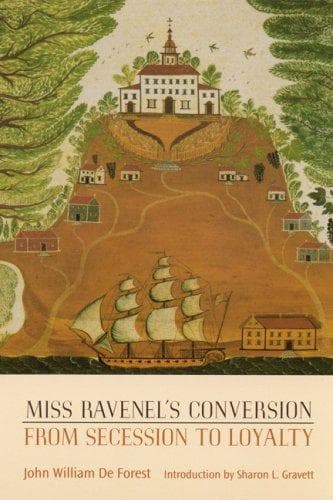
Miss Ravenel's conversion from secession to loyalty — John Shaqi
Miss Ravenel's conversion from secession to loyaltyDe Forest, John William
History
Miss Ravenel's conversion from secession to loyalty
De Forest, John William
Historical fiction; United States -- History -- Civil War, 1861-1865 -- Fiction; War stories; Women -- United States -- Fiction
I must not allow the reader to suppose that I present Carter as a type
of all regular officers. There were men in the old army who never tasted
liquors, who never blasphemed, who did not waste their substance in
riotous living, who could be accused of no evil practices, who were
models of Christian gentlemen. The American service, as well as the
English, had its Havelocks, its Headly Vicars, its Colonel Newcomes.
Nevertheless I do venture to say that it had also a great many men whose
moral habits were cut more or less on the Carter pattern, who swore
after the fashion of the British army in Flanders, whose heads could
carry drink like Dugald Dalgetty's, and who had even other vices
concerning which my discreet pen is silent.
Within a week after the conversation above reported Colburne opened a
recruiting office, advertised the "Putnam Rangers" largely, and adorned
his doorway with a transparency representing Old Put in a brand-new
uniform riding sword in hand down the stone steps of Horse-neck. His
company, as yet in embryo, was one of the ten accepted out of the
nineteen offered for Carter's regiment. It was supposed that the name of
a West Point colonel would render the organization a favorite one with
the enlisting classes; and accordingly all the chiefs of incomplete
companies throughout the State of Barataria wanted to seize the chance
for easy recruiting. But Colburne soon found that the dullness of a
young lawyer's office was none too prosy an exordium for the dullness of
a recruiting office at this particular period. Passed was that
springtide of popular enthusiasm when companies were raised in a day,
when undersized heroes wept at being rejected by the mustering officer,
when well-to-do youths paid a hundred dollars to buy out a chance to be
shot at. Bull Run had disenchanted some romantic natures concerning the
pleasures of war, and the vast enlistments of the summer had drawn
heavily on the nation's fighting material. Moreover, Colburne had to
encounter obstacles of a personal nature, such as did not trouble some
of his competitors. A student, a member of a small and shy social
circle, neither business man nor one of the bone and sinew, not having
belonged to a fire company or militia company, nor even kept a bar or
billiard-saloon, he had no retainers nor partisans nor shopmates to call
upon, no rummy customers whom he could engage in the war-dance on
condition of unlimited whiskey. He had absolutely no personal means of
influencing the classes of the community which furnish that important
element of all military organizations, private soldiers. For a time he
remained almost as solitary in his office as Old Put in the perilous
glory of his breakneck descent. In short the raising of his company
proved a slow, vexatious and expensive business, notwithstanding the
countenance and aid of the Colonel.
Public-domain text, read in full here on John Shaqi.
Reviews
Reviews
No reviews yet
Be the first to share your thoughts on this work.
Join the Discussion
Join the discussion
Sign in to leave a comment or review.
Sign InorCreate an account