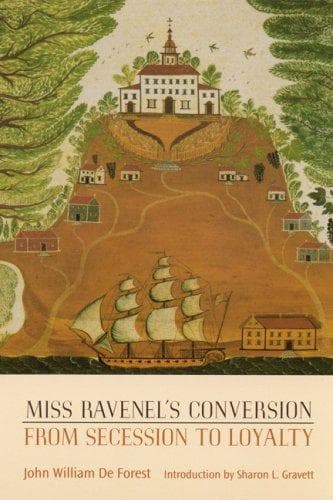
Miss Ravenel's conversion from secession to loyaltyDe Forest, John William
History
Miss Ravenel's conversion from secession to loyalty
De Forest, John William
Historical fiction; United States -- History -- Civil War, 1861-1865 -- Fiction; War stories; Women -- United States -- Fiction
"No," said the Colonel. "I beg your pardon; but don't tell him. It would
not be policy, it would not be soldierly, to inform him of any thing
likely to disgust him with the service."
CHAPTER VIII.
THE BRAVE BID GOOD-BYE TO THE FAIR.
Another circumstance disgusted Colonel Carter even more than the affair
of the majority. He received a communication from the War Department
assigning his regiment to the New England Division, and directing him to
report for orders to Major-General Benjamin F. Butler. Over this paper
he fired off such a volley of oaths as if Uncle Toby's celebrated army
in Flanders had fallen in for practice in battalion swearing.
"A civilian! a lawyer, a political wire-puller! a militiaman!" exclaimed
the high-born southern gentleman, West Point graduate and ex-officer of
the regular army. "What does such a fellow know about the organization
or the command of troops! I don't believe he could make out the property
returns of a company, or take a platoon of skirmishers into action. And
I must report to him, instead of he to me!"
Let us suppose that some inconceivably great power had suddenly created
the Colonel a first-class lawyer, and ordered the celebrated
Massachusetts advocate to act under him as junior counsel. We may
conjecture that the latter might have been made somewhat indignant by
such an arrangement.
"I'll make official application to be transferred to some other
command," continued Carter, thinking to himself. "If that won't answer,
I'll go to the Secretary myself about it, irregular as personal
application may be. And if that won't answer, I'll be so long in getting
ready for the field, that our Major-General Pettifogger will probably go
without me."
If Carter attempted to carry out any of these plans, he no doubt
discovered that the civilian General was greater than the West Point
Colonel in the eyes of the authorities at Washington. But it is probable
that old habits of soldierly obedience prevented him from offering much
if any resistance to the will of the War Department, just as it
prevented him from expressing his dissatisfaction in the presence of any
of his subordinate officers. It is true that the Tenth was an
unconscionable long time in getting ready for the field, but that was
owing to the decay of the enlisting spirit in Barataria, and Carter
seemed to be as much fretted by the lack of men as any body. Meantime
not even Colburne, the officer to whom he unbosomed himself the most
freely, overheard a syllable from him in disparagement of General
Butler.
Public-domain text, read in full here on John Shaqi.
Reviews
Reviews
No reviews yet
Be the first to share your thoughts on this work.
Join the Discussion
Join the discussion
Sign in to leave a comment or review.
Sign InorCreate an account