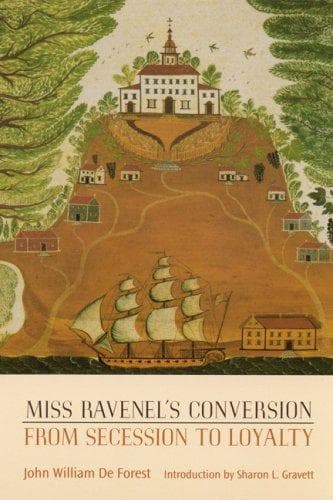
Miss Ravenel's conversion from secession to loyaltyDe Forest, John William
History
Miss Ravenel's conversion from secession to loyalty
De Forest, John William
Historical fiction; United States -- History -- Civil War, 1861-1865 -- Fiction; War stories; Women -- United States -- Fiction
"I should be truly delighted," he said, "I should consider it one of the
greatest honors possible to me--if I could do something towards opening
your way back to your own home."
"Oh! I wish you could," she replied with enthusiasm. "I do so want to
get back to Louisiana. But I don't want the South whipped. I want
peace."
"Do you? That is a bad wish for me," observed Carter, with his
characteristic frankness, coolly wondering to himself how he would be
able to live without his colonelcy. As to how he could pay the thousand
or two which he owed to tailors, shoemakers, restaurateurs and wine
merchants, that was never to him a matter of marvel or of anxiety, or
even of consideration.
In obedience to a curious instinct which exists in at least some
feminine natures, Miss Ravenel liked the Colonel, or at least felt that
she could like him, just in proportion as she feared him. A man who can
make some women tremble, can, if he chooses, make them love. Pure and
modest as this girl of eighteen was, she could, and I fear, would have
fallen desperately in love with this toughened worldling, had he, with
his despotic temperament, resolutely willed it. In justice to her it
must be remembered that she knew little or nothing about his various
naughty ways. In her presence he never swore, nor got the worse for
liquor, nor alluded to scenes of dissipation. At church he decorously
put down his head while one could count twenty, and made the responses
with a politeness meant to be complimentary to the parties addressed.
Her father hinted; but she thought him unreasonably prejudiced; she made
what she considered the proper allowance for men who wore uniforms. She
had very little idea of the stupendous discount which would have to be
admitted before Colonel Carter could figure up as an angel of light, or
even as a decently virtuous member of human society. She thought she
stated the whole subject fairly when she admitted that he might be
"fast;" but she had an innocently inadequate conception of the meaning
which the masculine sex attaches to that epithet. She applied it to him
chiefly because he had the monumental self-possession, the graceful
audacity, the free and easy fluency, the little ways, the general air,
of certain men in New Orleans who had been pointed out to her as "fast,"
and concerning whom there were dubious whisperings among elderly
dowagers, but of whom she actually knew little more than that they had
good manners and were favorites with most ladies. She had learned to
consider the type a satisfactory one, without at all appreciating its
moral signification. That Colonel Carter had been downright wicked and
was still capable of being so under a moderate pressure of temptation,
she did not believe with any realizing and saving faith. Balzac says
that very corrupt people are generally very agreeable; and it may be
that this extraordinary fact is capable of a simple and sufficient
explanation.
Public-domain text, read in full here on John Shaqi.
Reviews
Reviews
No reviews yet
Be the first to share your thoughts on this work.
Elsewhere in the archive
Join the Discussion
Join the discussion
Sign in to leave a comment or review.
Sign InorCreate an account