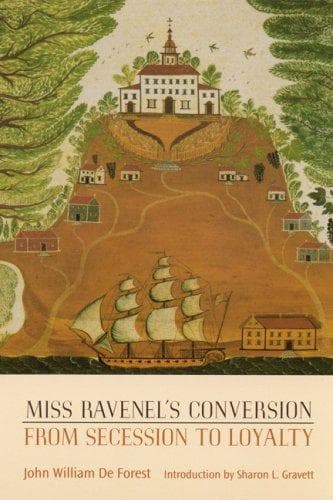
Miss Ravenel's conversion from secession to loyaltyDe Forest, John William
History
Miss Ravenel's conversion from secession to loyalty
De Forest, John William
Historical fiction; United States -- History -- Civil War, 1861-1865 -- Fiction; War stories; Women -- United States -- Fiction
"My conversation isn't half pungent enough to do justice to the perfume
of the subject," insisted the Doctor. "When I speak or try to speak of
that McAllister, and of similar people to be met there and everywhere, I
am obliged to admit the inadequacy of language. Nothing but the last
trump can utter a sound appropriate to such personages."
"But Colonel McAllister is a very respectable middle-aged planter now,
papa," said Lillie.
"Respectable! Oh, my child! do not persist in talking as if you were
still in the nursery. Saint Paul, Pascal, Wilberforce couldn't have
remained respectable if they had been slaveholding planters."
To Colonel Carter personally the Doctor was perfectly civil, as he was
to every one with whom he was obliged to come in contact, including the
reprobated McAllister and his similars. Even had he been of a combative
disposition, or been twice as prejudiced against Carter as he was, he
could not have brought himself in these days and with his present loyal
enthusiasm, to discourteously entreat an officer who wore the United
States uniform and who had bled in the cause of country against treason.
Moreover he felt a certain degree of good-will towards our military
_roué_, as being the patron of his particular friend Colburne. Of this
young man he seemed almost as fond as if he were his father, without,
however, entertaining the slightest thought of gaining him for a
son-in-law. I never knew, nor read of, not even in the most unnatural
novels, an American father who was a matchmaker.
So the autumn and half the winter passed away, without any one falling
in love, unless it might be Colburne. It needed all his good sense to
keep him from it; or rather to keep him from paying Miss Ravenel what
are called significant attentions; for as to his being in love, I admit
it, although he did not. To use old-fashioned language, alarming in its
directness and strength of meaning, I suppose he would have courted her
if she would have let him. But there was something in the young lady's
manner towards him which kept him at arm's length; which had the charm
of friendship, indeed, but no faintest odor of even the possibility of
love, just as certain flowers have beauty but no perfume; which said to
him very gently but also very firmly, "Mr. Colburne, you had better not
be in a hurry."
At times he was under sudden and violent temptation. The trusting Doctor
placed Lillie under his charge to go to one or two concerts and popular
lectures, following therein the simple and virtuous ways of New Boston,
where young ladies have a freedom which in larger and wickeder cities is
only accorded to married women. On the way to and from these amusements,
Lillie's hand resting lightly on his arm, and the obscurity of the
streets veiling whatever reproof or warning might sparkle in her eyes,
his heart was more urgent and his soul less timid than usual.
Public-domain text, read in full here on John Shaqi.
Reviews
Reviews
No reviews yet
Be the first to share your thoughts on this work.
Elsewhere in the archive
Join the Discussion
Join the discussion
Sign in to leave a comment or review.
Sign InorCreate an account