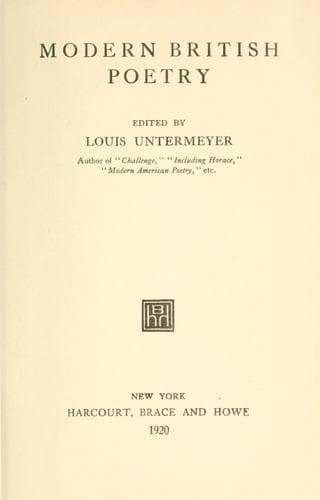
English poetry -- 19th century; English poetry -- 20th century
The Priests are singing in their stalls,
Their singing lifts, their incense burns, their praying clamours;
Yet God is as the sparrow falls,
The ivy drifts;
The votive urns
Are all left void when Fortune turns,
The god is but a marble for the kerns
To break with hammers; a tale, a dream.
O Beauty, let me know again
The green earth cold, the April rain, the quiet waters figuring sky,
The one star risen.
So shall I pass into the feast
Not touched by King, Merchant, or Priest;
Know the red spirit of the beast,
Be the green grain;
Escape from prison.
SONNET[18]
Is there a great green commonwealth of Thought
Which ranks the yearly pageant, and decides
How Summer's royal progress shall be wrought,
By secret stir which in each plant abides?
Does rocking daffodil consent that she,
The snowdrop of wet winters, shall be first?
Does spotted cowslip with the grass agree
To hold her pride before the rattle burst?
And in the hedge what quick agreement goes,
When hawthorn blossoms redden to decay,
That Summer's pride shall come, the Summer's rose,
Before the flower be on the bramble spray?
Or is it, as with us, unresting strife,
And each consent a lucky gasp for life?
FOOTNOTES:
[17] From _The Story of a Round-House_ by John Masefield. Copyright,
1913, by The Macmillan Company. Reprinted by permission of the
publishers.
[18] From _Good Friday and Other Poems_ by John Masefield. Copyright,
1916, by The Macmillan Company. Reprinted by permission of the
publishers.
_Lord Dunsany_
Edward John Moreton Drax Plunkett, Lord Dunsany, was born July 24,
1878, and was educated at Eton and Sandhurst. He is best known as an
author of fantastic fairy tales and even more fantastic plays. _The
Gods of the Mountain_ (1911) and _The Golden Doom_ (1912) are highly
dramatic and intensely poetic. _A Night at an Inn_ (1916) is that
peculiar novelty, an eerie and poetical melodrama.
Dunsany's prime quality is a romantic and highly colored imagination
which is rich in symbolism. After the World War, in which the
playwright served as captain in the Royal Innis-killing Fusiliers,
Dunsany visited America and revised the reissue of his early tales and
prose poems collected in his _The Book of Wonder_.
SONGS FROM AN EVIL WOOD
I
There is no wrath in the stars,
They do not rage in the sky;
I look from the evil wood
And find myself wondering why.
Why do they not scream out
And grapple star against star,
Seeking for blood in the wood
As all things round me are?
They do not glare like the sky
Or flash like the deeps of the wood;
But they shine softly on
In their sacred solitude.
To their high, happy haunts
Silence from us has flown,
She whom we loved of old
And know it now she is gone.
Public-domain text, read in full here on John Shaqi.
Reviews
Reviews
No reviews yet
Be the first to share your thoughts on this work.
Join the Discussion
Join the discussion
Sign in to leave a comment or review.
Sign InorCreate an account