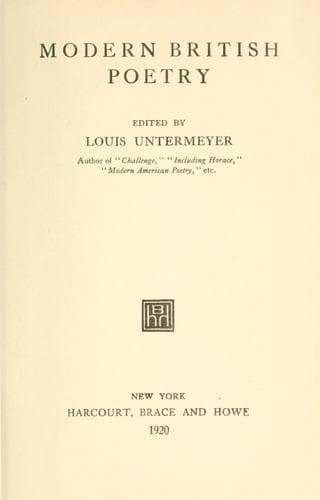
English poetry -- 19th century; English poetry -- 20th century
There they stand, on their ends, the fifty faggots
That once were underwood of hazel and ash
In Jenny Pinks's Copse. Now, by the hedge
Close packed, they make a thicket fancy alone
Can creep through with the mouse and wren. Next Spring
A blackbird or a robin will nest there,
Accustomed to them, thinking they will remain
Whatever is for ever to a bird.
This Spring it is too late; the swift has come,
'Twas a hot day for carrying them up:
Better they will never warm me, though they must
Light several Winters' fires. Before they are done
The war will have ended, many other things
Have ended, maybe, that I can no more
Foresee or more control than robin and wren.
COCK-CROW
Out of the wood of thoughts that grows by night
To be cut down by the sharp axe of light,--
Out of the night, two cocks together crow,
Cleaving the darkness with a silver blow:
And bright before my eyes twin trumpeters stand,
Heralds of splendour, one at either hand,
Each facing each as in a coat of arms:--
The milkers lace their boots up at the farms.
_Seumas O'Sullivan_
James Starkey was born in Dublin in 1879. Writing under the pseudonym
of Seumas O'Sullivan, he contributed a great variety of prose and
verse to various Irish papers. His reputation as a poet began with
his appearance in _New Songs_, edited by George Russell ("A. E.").
Later, he published _The Twilight People_ (1905), _The Earth Lover_
(1909), and _Poems_ (1912).
PRAISE
Dear, they are praising your beauty,
The grass and the sky:
The sky in a silence of wonder,
The grass in a sigh.
I too would sing for your praising,
Dearest, had I
Speech as the whispering grass,
Or the silent sky.
These have an art for the praising
Beauty so high.
Sweet, you are praised in a silence,
Sung in a sigh.
_Ralph Hodgson_
This exquisite poet was born in Northumberland about 1879. One of the
most graceful of the younger word-magicians, Ralph Hodgson will retain
his freshness as long as there are lovers of such rare and timeless
songs as his. It is difficult to think of any anthology of English
poetry compiled after 1917 that could omit "Eve," "The Song of Honor,"
and that memorable snatch of music, "Time, You Old Gypsy Man." One
succumbs to the charm of "Eve" at the first reading; for here is the
oldest of all legends told with a surprising simplicity and still more
surprising freshness. This Eve is neither the conscious sinner nor the
Mother of men; she is, in Hodgson's candid lines, any young, English
country girl--filling her basket, regarding the world and the serpent
itself with a mild and childlike wonder.
Hodgson's verses, full of the love of all natural things, a love that
goes out to
"an idle rainbow
No less than laboring seas,"
were originally brought out in small pamphlets, and distributed by
_Flying Fame_.
EVE
Public-domain text, read in full here on John Shaqi.
Reviews
Reviews
No reviews yet
Be the first to share your thoughts on this work.
Elsewhere in the archive
Join the Discussion
Join the discussion
Sign in to leave a comment or review.
Sign InorCreate an account