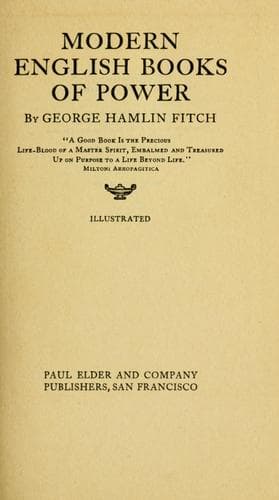
English literature -- 19th century -- History and criticism
The boy was a mental prodigy, for he taught himself to read when four
years old, and at five he had devoured hundreds of books and was
already writing poems and plays. At ten, when he had his first tutor,
his knowledge was wide and he had become a passionate lover of natural
scenery, as well as no mean artist with pen and pencil. Scott's novels
and Byron's _Childe Harold_ formed much of his reading at a time when
most boys are content with the stories of Ballantyne or Mayne Reid.
The range of his mental activity until he entered Oxford at eighteen
was very wide. He was interested in mineralogy, meteorology,
mathematics, drawing and painting. What probably expanded his mind
more than all else was the education of travel. His father spent about
half his time journeying through England and the Continent in an
old-fashioned chaise and John always shared in these expeditions. At
Oxford he competed for the Newdigate prize in poetry, and after being
twice defeated won the coveted honor. He never gained any high
scholarship, but he received valuable training in writing.
There is no space here to chronicle more than a few of his many
activities after leaving college. He first came into prominence by his
passionate defense of the painter Turner against the art critics, and
his study of Turner led him to adopt art criticism as his life work.
At twenty-three years of age, when most youths are puzzled about their
vocation, Ruskin had completed the first volume of _Modern Painters_,
the publication of which gave him fame and made him a social lion in
London. Other volumes of this great work followed swiftly and caused a
great commotion in the world of art and letters because of the radical
views of the author and the remarkable qualities of his style.
This was followed by _The Seven Lamps of Architecture_, in which
Ruskin expounded his radical views on this kindred art; _The Stones of
Venice_, an eloquent book enforcing the argument that Gothic
architecture sprang from a pure national faith and the domestic
virtues; _King's Treasuries_, a noble plea for good books; _Fors
Clavigera_, a series of ninety-six parts published in eight volumes,
the record of his social experiments; _Preterita_, one of the most
charming books of youthful reminiscences in any language, and many
others. Ruskin's mental activity was enormous. He had to his credit in
his fifty-five active years no less than seventy-two volumes and one
hundred magazine articles, as well as thousands of lectures.
Public-domain text, read in full here on John Shaqi.
Reviews
Reviews
No reviews yet
Be the first to share your thoughts on this work.
Join the Discussion
Join the discussion
Sign in to leave a comment or review.
Sign InorCreate an account