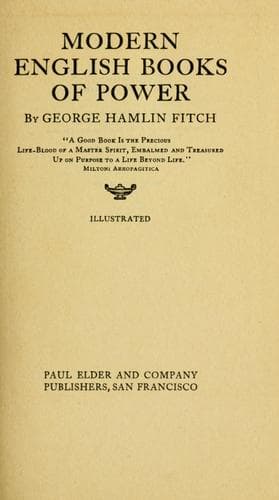
English literature -- 19th century -- History and criticism
This outline sketch of Ruskin's life would be incomplete without
mention of the great sorrows that darkened his days but gave eloquence
to his writings. The first was the desertion of his wife, who married
the painter Millais, and the second was the loss by death of Rose La
Touche, a beautiful Irish girl whom he had known from childhood. She
refused to marry him because of their differences of religion; even
refused to see him in her fatal illness unless he could say that he
loved God better than he loved her. Her death brought bitter despair
to Ruskin, but the world profited by it, for grief gave his work
maturity and force. The last ten years of Ruskin's life were spent at
his beautiful home at Brantwood, surrounded by the pictures that he
loved and served faithfully by devoted relatives.
[Illustration: JOHN RUSKIN FROM THE SEMI-ROMANTIC PORTRAIT OF SIR
JOHN E. MILLAIS]
Ruskin's books are not to be read continuously. Many dreary passages
may be found in all of them, which the judicious reader skips. But his
best works are more full of intellectual stimulus than those of any
writer of his time with the single exception of Carlyle. _Modern
Painters_ overflows with the enthusiasm of a lover of art and of
nature who preaches the gospel of sincerity and truth. It is marked,
like all his work, by eloquent digressions on human life and conduct,
for Ruskin held that the finest art was simply the flowering of a
great soul nurtured on all that was highest and best. _The Seven
Lamps_ does for architecture what his first work did for painting. The
book is written in more ornate style than any other, but he who loves
impassioned prose will find many specimens here that can only by
equaled in De Quincey's best work. Read the peroration of the "Lamp
of Sacrifice" and you will not need to be told that this is the finest
tribute to the work of the builders of the mediaeval cathedral. Here is
a part of this eloquent passage:
It is to far happier, far higher exaltation that we owe those
fair fronts of variegated mosaic, charged with wild fancies
and dark hosts of imagery, thicker and quainter than ever
filled the depth of midsummer dream; those vaulted gates,
trellised with close leaves; those window labyrinths of
twisted tracery and starry light; those misty masses of
multitudinous pinnacle and diademed tower; the only witnesses,
perhaps, that remain to us of the faith and fear of nations.
All else for which the builders sacrificed has passed away.
* * * But of them and their life and their toil upon earth,
one reward, one evidence, is left to us in those great heaps
of deep-wrought stone. They have taken with them to the grave
their powers, their honors and their errors; but they have
left us their adoration.
Public-domain text, read in full here on John Shaqi.
Reviews
Reviews
No reviews yet
Be the first to share your thoughts on this work.
Join the Discussion
Join the discussion
Sign in to leave a comment or review.
Sign InorCreate an account