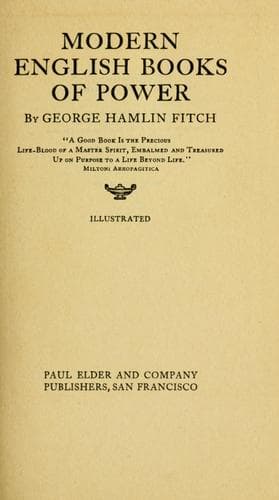
English literature -- 19th century -- History and criticism
Many a night I saw the Pleiades, rising through the mellow shade,
Glitter like a swarm of fireflies tangled in a silver braid.
Love took up the harp of Life, and smote on all the chords with might;
Smote the chord of Self, that, trembling, pass'd in music out of sight.
Cursed be the sickly forms that err from honest Nature's rule!
Cursed be the gold that gilds the straiten'd forehead of a fool!
Comfort? Comfort scorn'd of devils! this is truth the poet sings,
That a sorrow's crown of sorrow is remembering happier things.
But the jingling of the guinea helps the hurt that Honor feels,
And the nations do but murmur, snarling at each other's heels.
Mated with a squalid savage--what to me were sun or clime?
I the heir of all the ages in the foremost files of time.
Not in vain the distance beacons. Forward, forward, let us range,
Let the great world spin forever down the ringing grooves of change.
Thro' the shadow of the globe we sweep into the younger day:
Better fifty years of Europe than a cycle of Cathay.
It would be difficult among the poets of the last century to parallel
these passages for their imaginative sweep and magnetic appeal to the
reader. The new criticism that disparages Tennyson and raises Browning
to the seventh heaven calls _Locksley Hall_ old-fashioned and
sentimental, but to me it is the greatest poem of its age. Next to
this I would place _In Memoriam_, which has never received its just
recognition. Readers of Taine will recall his flippant Gaelic comment
on Tennyson's conventional but cold words of lament. Nothing, it seems
to me, is further from the truth. The many beautiful lines in the poem
depict the changing moods of the man who mourned for his dead and
finally found comfort in the words of the Bible--the only source of
comfort in this world for the sorely wounded heart. The whole poem, as
his son Hallam says, emphasizes the poet's belief "in an omnipotent
and all-loving God, who has revealed himself through the highest
self-sacrificing love in the freedom of the human will and in the
immortality of the soul."
The meter of _In Memoriam_ serves to fix the poem in the memory. It
seems to fit the thought with perfect naturalness. It is not strange
that Queen Victoria should have placed this poem next to the Bible as
a means of comfort after the loss of her husband, whom she loved so
dearly that all the attractions of power and wealth never made her
forget him a single day.
Public-domain text, read in full here on John Shaqi.
Reviews
Reviews
No reviews yet
Be the first to share your thoughts on this work.
Elsewhere in the archive
Join the Discussion
Join the discussion
Sign in to leave a comment or review.
Sign InorCreate an account